


Research Papers/Articles

Analysis of Intellectual Property Law Gaps in Ethiopia and Beyond
2019
Author(s): Boki I
This paper analyzed the legal protection accorded to IK at international, regional and national level with particular emphasis to the legal gaps within Ethiopia’s Intellectual Property (IP) legal frameworks. This paper found that there are legal gaps/lacuna within the existing IP laws and other related laws which aimed at protecting knowledge, innovations and practices in general and with regard to the protection of IK in particular.

Missing and Murdered Indigenous Women (MMIW): Bringing Awareness Through the Power of Student Activism
2019
Author(s): Isaacs DS, Young AR
This article narrates the stories of two Native American women who are using their power and privilege as it intersects with lived experience to bring awareness to the epidemic of Missing and Murdered Indigenous Women (MMIW). The article brings light to what drives them to promote social justice movements and how they work to institute positive change.

Addressing the Suppressed Epidemic: Violence Against Indigenous Women
2019
Author(s): Young AR
This purpose of this article is to explore issues relevant to understanding the current high rates of the intergenerational suppressed epidemic of violence against indigenous women and how the general public can use this information to aid in lowering this epidemic.

Indigenous Technical Knowledge (ITK) Practiced by Dairy and Piggery Farmers in Meghalaya
2019
Author(s): Shadap DM, Dkhar SE
The study was conducted in two districts viz. East Khasi Hills and Ri-Bhoi districts taking two villages from each district on Indigenous Technical Knowledge (ITK) in the field of animal husbandry and veterinary.

Agro-forestry: An Alternative for Jhum Cultivation in Meghalaya
2019
Author(s): Shangpliang LM
Jhum cultivation is considered highly destructive to environment as it involves burning and clearing vast areas of forest so that cultivation can be done for a few years. It does not only destroy forest but has a chain of effects and after-effects leading to multifarious adverse conditions of soil and climate.
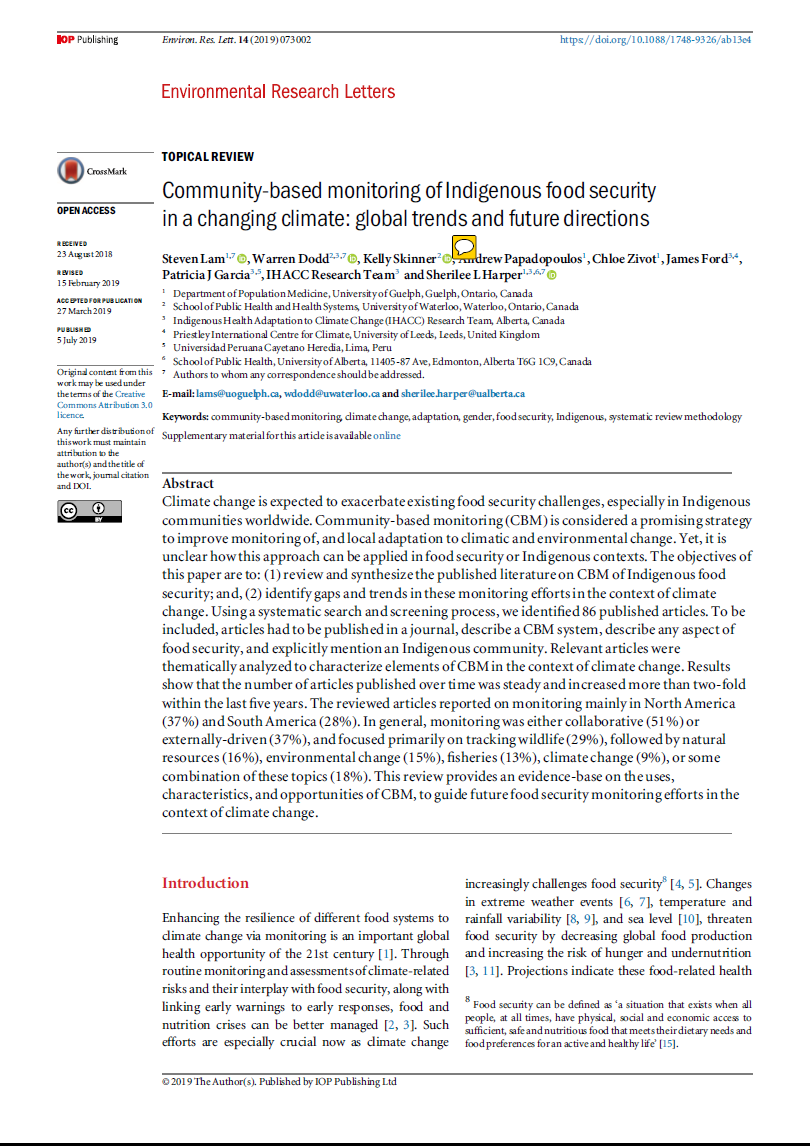
Community-Based Monitoring of Indigenous Food Security in a Changing Climate: Global Trends and Future Directions
2019
Author(s): Lam S, Dodd W, Skinner K, Papadopoulos A, Zivot C, Ford J, Garcia PJ, Harper SL
This review provides an evidence-base on the uses, characteristics, and opportunities of CBM, to guide future food security monitoring efforts in the context of climate change.

Dyeing of Eri Silk With Natural Dyes in Presence of Natural Mordants
2018
Author(s): Banerjee AN, Kotnala OP, Maulik SR
Camellia sinensis (L.) Kuntze (tea leaves), Allium cepa L. (onion peel), Laccifer lacca Kerr (lac insect) and iron ore are used as natural dyes in presence of different natural mordanting agents for dyeing of Eri silk yarns in Meghalaya.

Indigenous Approaches of Orchid Pest Management in North East India
2018
Author(s): Meena NK, Pal R ,Barman D, Pant RP
Pest infestation is one of the major factors limiting the quality production of these flowers. Twelve locations from five North eastern states, i.e., Sikkim, Assam, Meghalaya, Arunachal Pradesh and Darjeeling and Kalimpong of West Bengal were taken in this study.

Kali Haldi, an Ethnomedicinal Plant of Jharkhand state- A review
2018
Author(s): Mahato D, Sharma HP
In the present review article various established facts related to the plant Curcuma caesia have been compiled so that proper scientific methods can be initiated to validate its traditional uses and open the door for a source of potential drugs in near future.
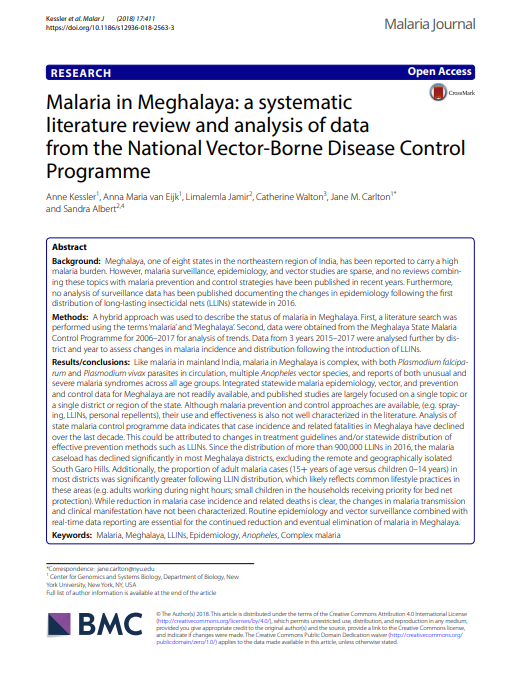
Malaria in Meghalaya: A Systematic Literature Review and Analysis of Data from the National Vector-Borne Disease Control Programme
2018
Author(s): Kessler A, Eijk AM, Jamir L, Walton C, Carlton JM
This study was carried out to undertake literature review of malaria in Meghalaya, with the goal of summarizing what is known about malaria epidemiology, vectors, and prevention methods in the state; and second, to undertake an analysis of statewide malaria epidemiology data from 2015-2017 to evaluate the effect of the introduction of LLINs.