


Research Papers/Articles
Plants and Culture: Plant Utilization Among the Local Communities in Kabayan, Benguet Province, Philippines
2018
Author(s): Balangcod TD, Balangcod KD
This paper provides an overview of the project undertaken in Cordillera region in the northern most part of the Philippines to determine the useful plants and document the traditional knowledge that are associated with the useful plants.

Studying an Indigenous Rainwater Harvesting System in Banni Grassland of Kachchh, India
2018
Author(s): Machiwal D, Kumar S, Sharma GK , Jat SR, Dayal D
This study focuses on an indigenous rainwater harvesting system, locally known as virda that was evolved centuries ago in Banni grassland of Kachchh, Gujarat, India.

Survey of Wild Food Plants for Human Consumption in Karaisalı (Adana-Turkey)
2018
Author(s): Güneş S , Savran A, Paksoy MY, Çakılcıoğlu U
The study showed that the plants used are either eaten raw or ripe, cooked as vegetable dish, consumed as jam, consumed as coffee, as spice, frying in oil or baked to be served as dishes such as stew, pie made by roasting the leaves, prepared sour souce is added to food.
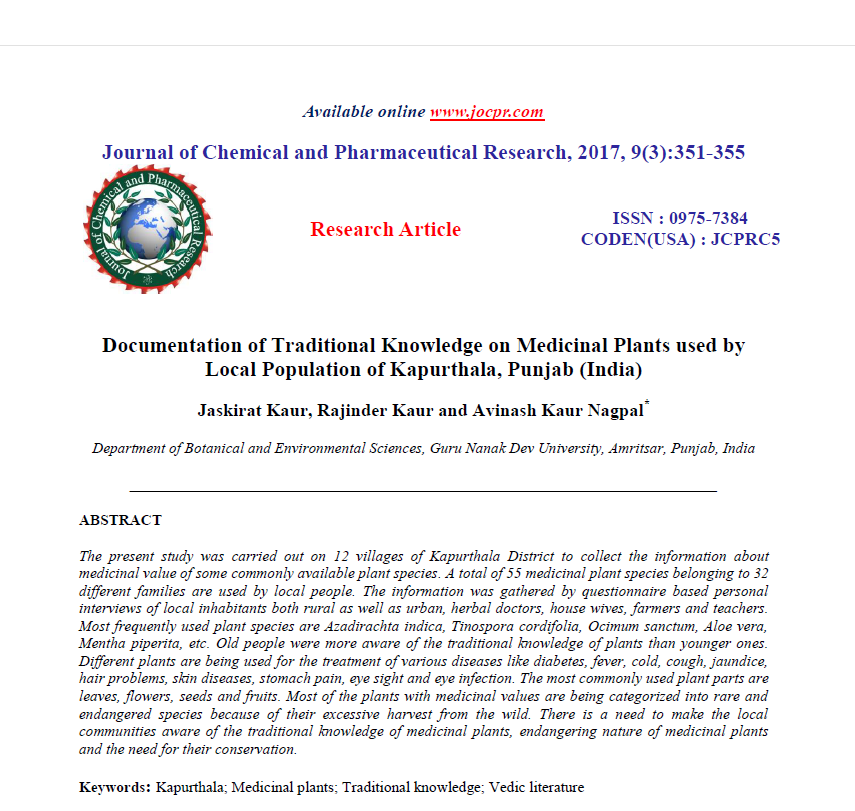
Documentation of Traditional Knowledge on Medicinal Plants used by Local Population of Kapurthala, Punjab (India)
2017
Author(s): Kaur J, Kaur R and Nagpal AK
A total of 55 medicinal plant species belonging to 32 different families are used by local people. The information was gathered by questionnaire based personal interviews of local inhabitants both rural as well as urban, herbal doctors, house wives, farmers and teachers. Most frequently used plant species are Azadirachta indica, Tinospora cordifolia, Ocimum sanctum, Aloe vera, Mentha piperita, etc.

Ethnoveterinary Practices Among Women of Banaskantha District, Gujarat
2017
Author(s): Khandelwal N
A survey was conducted for documenting indigenous knowledge used by rural women for animal healthcare in and around Dantiwada taluka of Banaskantha district, Gujarat.

Gender, Climate Change, and Resilient Food Systems
2017
Author(s): Nkengla-Asi L
This study aims to understand how men and women in Cameroon’s Southwest region differ in their vulnerability to and their coping strategies for climate change impacts.Understanding such gender differences could facilitate the development of gender-sensitive policies and programs and could help improve sustainable and more inclusive adaptation strategies.
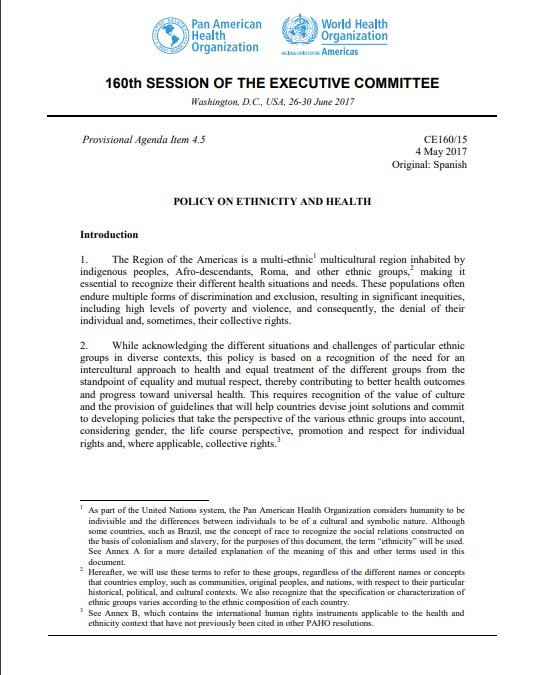
Policy on Ethnicity and Health
2017
Author(s): Pan American Health Organization
This policy is framed in the context of major global agreements and initiatives that recognize the need to guarantee respect for individual and, when applicable, collective rights and the health systems of traditional peoples, and to refocus health services by adopting an intercultural approach to advance with equity and social justice toward the enjoyment of the highest attainable standard of health and other human rights by indigenous peoples, Afro-descendants, Roma, and other ethnic groups.
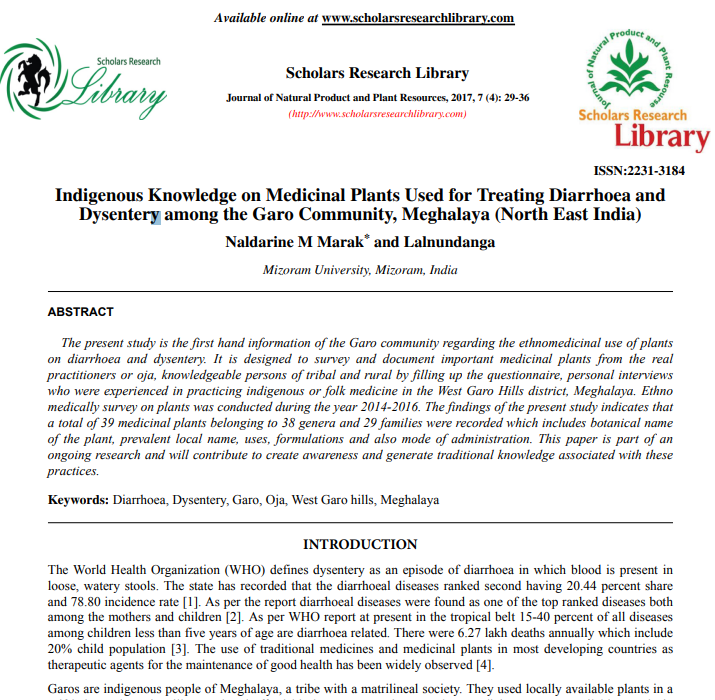
Indigenous Knowledge on Medicinal Plants Used for Treating Diarrhoea and Dysentery among the Garo Community, Meghalaya (North East India)
2017
Author(s): Marak NM, Lalnundanga
Ethnomedically survey on plants was conducted during the year 2014-2016. The findings of the present study indicates that a total of 39 medicinal plants belonging to 38 genera and 29 families were recorded which includes botanical name of the plant, prevalent local name, uses, formulations and also mode of administration.

Ethnomedicinal Practices for Tooth Problems by the Tribals of Khammam District, Andhra Pradesh, India
2017
Author(s): Manjula RR, Reddi TVVS
The paper deals with 46 species of plants, covering 44 genera and 31 families used for curing tooth ailments by the tribes of Khammam district in Andhra Pradesh. Fabaceae is the dominant family with 5 species followed by Myrtaceae and Solanaceae (each 3 species) and others.
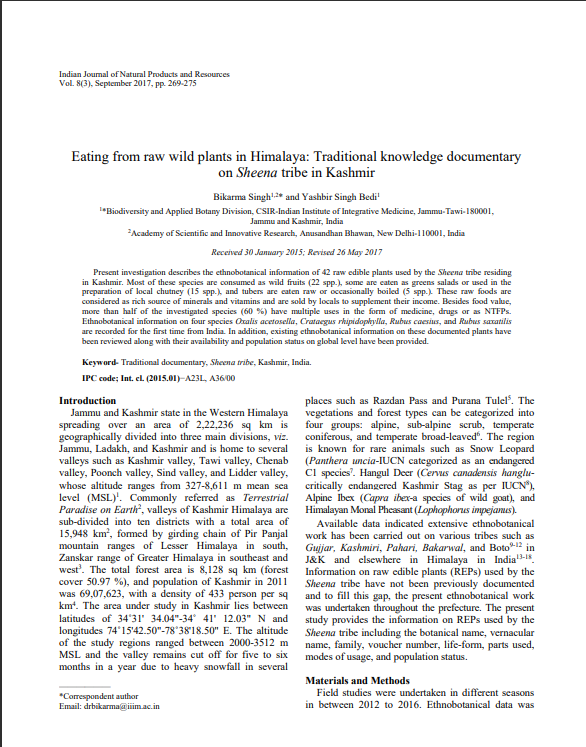
Eating from Raw Wild Plants in Himalaya: Traditional Knowledge Documentary on Sheena Tribe in Kashmir
2017
Author(s): Singh B, Bedi YS
This paper describes the ethnobotanical information of 42 raw edible plants used by the Sheena tribe residing in Kashmir. Besides food value, more than half of the investigated species (60 %) have multiple uses in the form of medicine, drugs or as NTFPs.