


Knowledge Hub
This study is about Indigenous Psychology which can include land-based indicators of validity and reliability.

Gender and national climate planning : Gender integration in the revised Nationally Determined Contributions
2021
Author(s): International Union for Conservation of Nature and Natural Resources
This study aims to: contribute to global and regional gender-climate policy data; enrich regional and national information to better target assistance to countries, their stakeholders and supporters; and inform more robust gender-responsive policymaking, knowledge and action at greater scales.

Agriculture Food Systems Transformation: From Strategy to Action
2021
Author(s): Food and Agriculture Organization of the United Nations FAO
This paper focuses on how FAO provides ways for better production, better nutrition, a better environment, and a better life, using a systems-based approach to tackle the complex challenges, FAO is working to accelerate innovation, technology, data, governance, and institutions to transform today’s agri-food systems for tomorrow’s world.

This book explores how local communities around the world are successfully responding to threats to the environment and local livelihoods. As communities continue to make a difference at the forefront of conservation, it is an auspicious moment to explore the links of community environmental stewardship, sustainable livelihoods and government engagement, and to appreciate the ‘power of community’.

Towards a Biocultural Heritage Territory in Rabai Cultural Landscape: Exploring Mijikenda Cultural Values and Practices for Sustainable Development
2021
Author(s): Wekesa C, Ndalilo L, Swiderska K
This case study in Kenya was conducted with the Rabai sub-tribe of the Mijikenda Indigenous community in Kilifi County, coastal Kenya. It was coordinated by the Kenya Forestry Research Institute (KEFRI), working closely with the Rabai community.
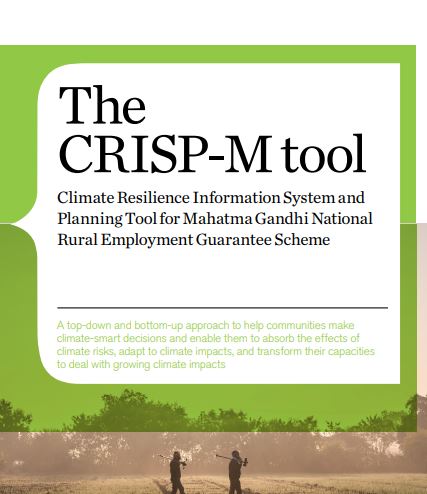
To assist MGNREGS to amplify the climate resilience impacts of its work, IIED in partnership with Madhya Pradesh Council of Science & Technology (MPCST) co-developed the Climate Resilience Information System and Planning Tool for MGNREGS (CRISP-M). A top-down and bottom-up approach to help communities make climate-smart decisions and enable them to absorb the effects of climate risks, adapt to climate impacts, and transform their capacities to deal with growing climate impacts.

Regenerative Agriculture supports Integrated Farm Management
2021
Author(s): LEAF (Linking Environment And Farming)
IFM is a site-specific, whole farm approach that blends the best of modern technology and traditional methods, providing a framework to support farmers with continuous improvement.

Indigenous Activists on Tackling the Climate Crisis: 'We Have Done More Than Any Government'
2021
Author(s): Guardian News
Nina Gualinga, Hindou Oumarou Ibrahim, Charitie Ropati, Sara-Elvira Kuhmunen, Emmanuela Shinta and Amelia Telford also told us about what they want to see from world leaders at the Cop26 summit and what makes them hopeful about the future. This video was amended on 30 November 2022 to fix an inaccuracy on Borneo map.

Arctic knowledge Echoes from the North : Conversations with Arctic Indigenous People and Others Concerned
2021
Author(s): Manrique RD, Pereira GA, Zoghbi J
The report describes ongoing impacts on Arctic livelihoods through the voices of Arctic residents. It represents a contribution to a broader call for mobilising all relevant knowledge about Arctic environmental change and resilience, which impact not only Arctic inhabitants but also all populations on the planet.Furthermore, the report explores the interplay of traditional knowledge with scientific research practices, highlighting the key essential conditions found in successful cases of collaboration between traditional knowledge-holders and scientists.

North Australian Remote BNH Training : Training Manual
2021
Author(s): Bush Fire and Natural Hazards CRC
This project aims to provide a ‘next-generation’ training program that builds on the work that has gone before and leads to increasing levels of competence and confidence and, in its turn, resilience for their communities. The project is a direct response to north Australian stakeholder concerns about existing training; that it is inadequate for their needs.