


Research Papers/Articles
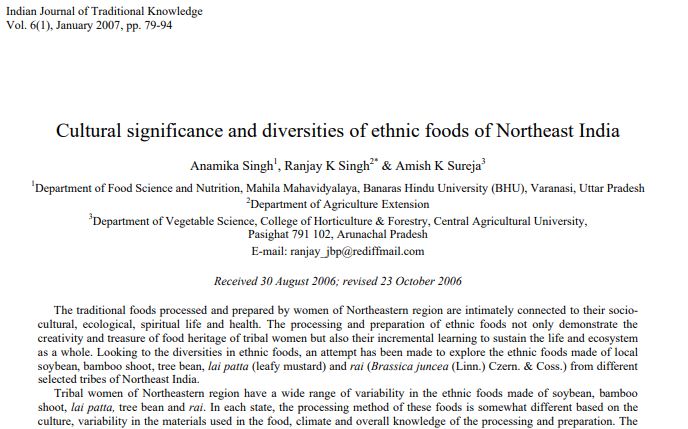
Cultural Significance and Diversities of Ethnic Foods of Northeast India
2007
Author(s): Singh A, Singh RK
The processing and preparation of ethnic foods not only demonstrate the creativity and treasure of food heritage of tribal women but also their incremental learning to sustain the life and ecosystem as a whole. Looking to the diversities in ethnic foods, an attempt has been made to explore the ethnic foods made of local soybean, bamboo shoot, tree bean, lai patta (leafy mustard) and rai (Brassica juncea (Linn.) Czern. & Coss.) from different selected tribes of Northeast India.
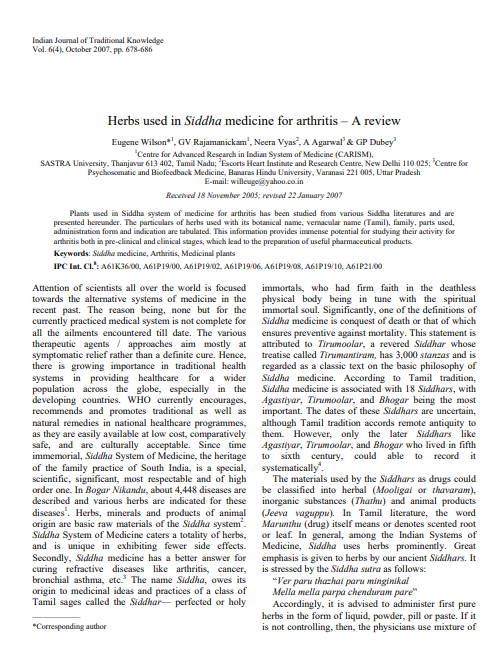
Herbs Used in Siddha Medicine for Arthritis – A review
2007
Author(s): Wilson, Eugene Rajamanickam, GV Vyas, Neera Agarwal, A Dubey, GP
This information provides immense potential for studying their activity for arthritis both in pre-clinical and clinical stages, which lead to the preparation of useful pharmaceutical products.

Ethnomedicinal Uses of Barks in Jalgaon District
2007
Author(s): Pawar S , Patil D A
This paper reports their botanical identity, family, local names, parts used, preparations and doses, if any. It was observed that tribal people use barks of various trees in the form of decoction, infusion, extract, paste, poultice, powder, etc.

Edible Weeds of Tribals of Jharkhand, Orissa and West Bengal
2007
Author(s): Sinha R, Lakra V
The study identifies 43 species of weeds belonging to 36 genera and 26 families that are commonly consumed by the tribal population as per their availability.

Indigenous Peoples in Latin America: Economic Opportunities and Social Networks
2007
Author(s): Patrinos H A, Skoufias E, Lunde T
Previous studies show that being indigenous is associated with being poor, and that over time that relation has stayed constant. Studies also show that indigenous peoples’ poverty has not diminished over time, including over the period of the world’s first indigenous peoples decade, 1994-2004 (Hall and Patrinos 2006). Furthermore, indigenous peoples suffer from many other disadvantages, and even when they are able to accumulate human capital this does not translate into significantly greater earnings or a closing of the poverty gap with the non indigenous population.

This publication focuses on the present scope and trends of international policies and activities related to the protection and preservation of traditional knowledge. The publication is based on a series of educational events organized and conducted by LIENIP.
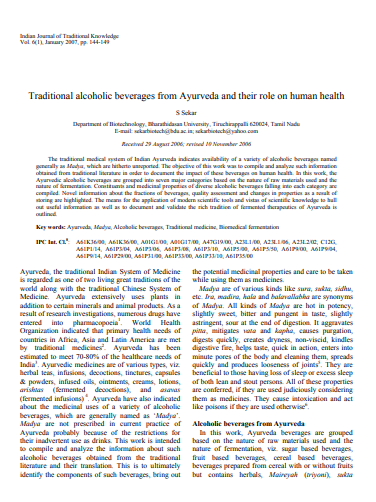
Traditional Alcoholic Beverages from Ayurveda and their Role on Human Health
2007
Author(s): Sekar S
The objective of this work was to compile and analyze such information obtained from traditional literature in order to document the impact of these beverages on human health.
Some Interesting Indigenous Beverages among the Tribals of Central India
2007
Author(s): Kumar V , Rao RR
The paper presents the detailed account of two important beverages, Handia and Mahua consumed by the tribals of Central India.
Traditional Knowledge on Wild Food Plants in Andhra Pradesh
2007
Author(s): Reddy KN , Pattanaik C, Reddy CS,Raju VS
The purpose of the study was to document the traditional wild food plants used by tribal people in Andhra Pradesh. A total of 156 species were documented as wild plants used for food purposes.
Traditional Medicinal Practices of Rajasthan
2007
Author(s): Sharma LK, Kumar A
During the course of investigation it has been observed that a particular plant is sometimes prescribed for different ailments in different localities and some Vaidyas (Ayurvedic physicians) apply a mixture of plants for remedy of diseases.