


Knowledge Hub

Indigenous peoples have begun a re-conceptualization of educational processes, emphasizing indigenous languages, spiritual beliefs, values, community involvement and connection to land, territories and resources. However, the process of achieving systemic change in education-related legislation and governance, human resources, curricula, materials and assessment, based on indigenous goals and aspirations, requires time, effort and resources. Hence, there is a critical need both for national and international support and for capacity-building to ensure that academics and professionals, especially among indigenous peoples, can act as leaders in effecting this significant paradigm shift.

Indigenous Knowledge: Enhancing Its Contribution to Natural Resources Management
2017
Author(s): Sillitoe P, Ainslie A, Amanor K
By drawing together strands of biocultural diversity research into natural resources management, this book: - Provides an overview of conceptual issues around IK and its contributions to sustainable agriculture and environmental conservation; - Addresses key themes via case studies from bioculturally diverse regions of the world; - Displays a wide range of methodologies and outlines a possible agenda to guide future work.

The Importance of Indigenous Rights and Knowledge in Conservation
2017
Author(s): IUCN, International Union for Conservation of Nature
Indigenous leaders and other participants at the IUCN World Conservation Congress 2016 discuss the value of indigenous rights, knowledge and leadership in creating more sustainable ways of life on Earth.

Research on Indigenous People and the Role of Information and Communications Technology in Development: A Review of the Literature
2017
Author(s): Du JT
Multiple empirical methods were used for the investigation, including case studies and surveys. Indigenous cultural and knowledge preservation, Indigenous literacy and education development, Indigenous people’s interactions with technologies, and the digital divide issues were identified as four main research topics. On the basis of the review, future research directions from an information research perspective are discussed.

Indigenous Agroforestry Practices by Orang Asli in Peninsular Malaysia: Management, Sustainability and Contribution to household economy
2017
Author(s): Keat NJ, Nath TK, Jose S
This study examined the indigenous management and sustainability of agroforestry practices, constraints experienced and contribution to household income. Data were collected from two Orang Asli villages practicing forest-garden agroforestry (FAF) and home garden agroforestry (HAF).

Linking People for Quality Products: Sustainable Interprofessional Bodies for Geographical Indications
2017
Author(s): Damary P , Bernardoni P , Couillerot C , Perret A
The content and theory pages of this training manual set out the basic concepts, while the exercise sheets provide for participative activities. The trainer notes, together with the introduction, guide trainers in the preparation of tailored training in relation to the five steps of the virtuous circle.

A traditional Food: Sunflower (Helianthus annuus L.) and Heather [Calluna vulgaris (L.) Hull] honeys
2017
Author(s): Özcan, Mehmet Musa Juhaimi, Fahad Al Uslu, Nurhan Ghafoor, Kashif Babiker, El Fadıl
The study discussed about the total phenolic contents of the honeys.

Gender, Climate Change, and Resilient Food Systems
2017
Author(s): Nkengla-Asi L
This study aims to understand how men and women in Cameroon’s Southwest region differ in their vulnerability to and their coping strategies for climate change impacts.Understanding such gender differences could facilitate the development of gender-sensitive policies and programs and could help improve sustainable and more inclusive adaptation strategies.
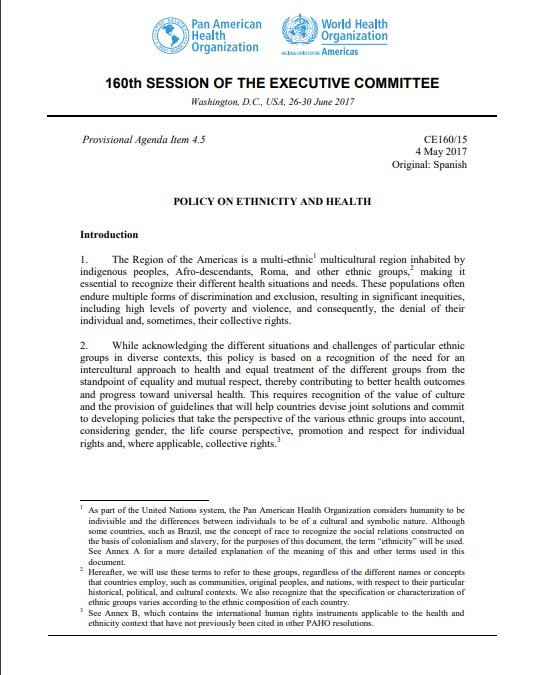
Policy on Ethnicity and Health
2017
Author(s): Pan American Health Organization
This policy is framed in the context of major global agreements and initiatives that recognize the need to guarantee respect for individual and, when applicable, collective rights and the health systems of traditional peoples, and to refocus health services by adopting an intercultural approach to advance with equity and social justice toward the enjoyment of the highest attainable standard of health and other human rights by indigenous peoples, Afro-descendants, Roma, and other ethnic groups.

Indigenous peoples are key to protecting wildlife and rural livelihoods
2017
Author(s): Food and Agriculture Organization of the United Nations - FAO
Sheila Wertz, FAO Senior Forestry Officer, explains the significant role of indigenous peoples plays in biodiversity conservation.