


Knowledge Hub

FAO, Indigenous Peoples and the Free, Prior and Informed Consent
2017
Author(s): Food and Agriculture Organization of the United Nations - FAO
Free, Prior and Informed Consent (FPIC) is a specific right that pertains to indigenous peoples and is recognized in the United Nations Declaration on the Rights of Indigenous Peoples (UNDRIP). FPI...

Implementing Indigenous Self - determination through Legislation in Canada
2017
Publisher/Organisation: John Borrows
Canada and Indigenous peoples should work together to produce legislation which recognizes and affirms Indigenous self-determination. While far from perfect, Indigenous peoples in the United States have created receptive policy frameworks with Congressional allies which builds law on principles of self-determination.

Ethnomedicinal Uses of Honey of Stingless Bee by Nepali community of Darjeeling foothills of West Bengal, Indiain Paraguay: Medicinal Plants Used for Deworming
2017
Author(s): Biswa R , Sarkar A , Khewa S
Surveys were carried out during 2010 to 2015 for identifying the use of honey of stingless bee, Lepidotrigona arcifera (Cockerell) in the ethnomedicine of Nepali community.

Briefing paper on Indigenous Peoples’ Rights and the 2030 Agenda
2017
Author(s): United Nations Department of Economic and Social Affairs
There is a strong commitment in the 2030 Agenda to empower and engage indigenous peoples in implementing and reviewing progress in achieving the goals. It is essential that the 2030 Agenda implementation is taken into account the principle of free, prior and informed consent and adequate consultations related to indigenous peoples’ lands and development priorities.

Addressing Agriculture, Forestry and Fisheries in National Adaptation Plans – Supplementary Guidelines
2017
Author(s): Karttunen K,Wolf J , Garcia C , Meybeck A
The Guidelines aim to support developing countries in: i) reducing vulnerability of the agriculture sectors to the impacts of climate change by building adaptive capacities and resilience; ii) addressing agriculture in the formulation and implementation of NAPs; and iii) enhancing the integration of adaptation in agricultural development policies, programmes and plans.

A Study on Cultivation and Yield Performance of Oyster Mushroom (Pleurotus ostreatus) on Wheat Straw Mixed with Horticultural Waste (Apple Pomace) in Different Ratio and their Nutritional Evaluation
2017
Author(s): Pathania S, Sharma N , Gupta D
The research experiment was carried out to investigate the cultivation of oyster mushroom on horticultural waste i.e. apple pomace and wheat straw mixed in the different ratio.

Antimicrobial and Phytochemical Screening of Trikuta - Traditional Food of Western Rajasthan
2017
Author(s): Sharma R, Kaur S
The study investigated the antibacterial property and phytochemical study of some specific dried products of western Rajasthan.

Agricultural transformation in Africa: The role of natural resources
2017
Author(s): Food and Agriculture Organization of the United Nations
This article outlines how pulses could contribute towards agricultural transformation and the attainment of Sustainable Development Goals in Africa. A quarter of the African population, most of whom are smallholder farmers deriving their livelihoods from rain fed agriculture, live in hunger and poverty. African governments should, among other measures, take advantage of the 2016 International Year of Pulses (IYP), declared by the United Nations' Food and Agriculture Organization (FAO), to stimulate both domestic consumption and exports of pulses to address this challenge.
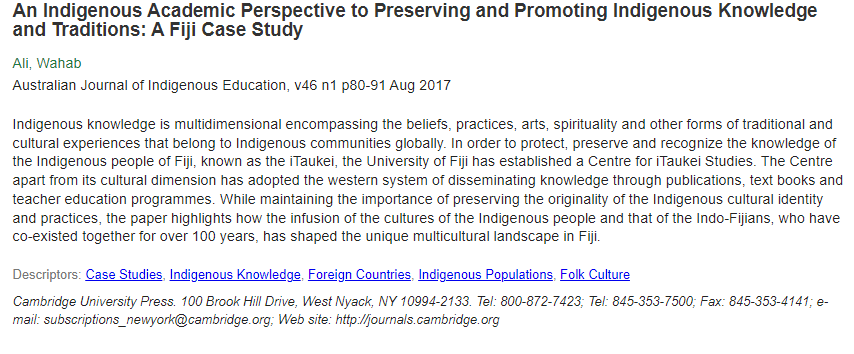
An Indigenous Academic Perspective to Preserving and Promoting Indigenous Knowledge and Traditions: A Fiji Case Study
2017
Author(s): Ali W
While maintaining the importance of preserving the originality of the Indigenous cultural identity and practices, the paper highlights how the infusion of the cultures of the Indigenous people and that of the Indo-Fijians, who have co-existed together for over 100 years, has shaped the unique multicultural landscape in Fiji.
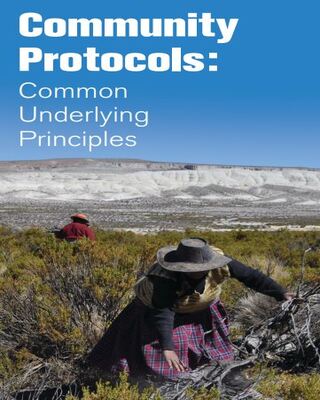
Community Protocols: Common Underlying Principles
2017
Publisher/Organisation: United Nations Environment Programme
Community protocols are an emerging concept in environmental law and policy. The term encompasses abroad range of practices and procedures, both written and unwritten, developed by indigenous peoples and their communities and other local communities (ILCs) in relation to their traditional knowledge (TK), territories, and natural and other resources. These practices and procedures cover a range of matters, including how ILCs expect external actors to engage with them