


Knowledge Hub

Guidelines for Combating Child Labour Among Indigenous and Tribal Peoples (ITPs)
2011
Author(s): International Labour Office
This guide provides practical guidance on how to address the specific needs and rights of indigenous peoples, and thus combat child labour among indigenous children.

This book examines the experiences and perceptions of indigenous peoples in the context of the national states and political systems that have been externally imposed and implemented upon them.

Traditional Knowledge and Intellectual Property Rights: An Indian Perspective
2011
Author(s): Bala A
Biopirates use Intellectual Property Rights (IPR) as tool to steal traditional knowledge and exploit biological resources and this happens because of some limitations in IPR system. Therefore it is required to introduce some sui-generis elements in the existing IPR system.

Indigenous Women Entrepreneurs in Papua GET Ahead
2011
Author(s): International Labour Organization
Like many other women who live in a patriarchal society, the indigenous women of Papua do not have many opportunities to take part in the development process. Their traditionally low status in the tribal hierarchy and poor education make them second-class members of society who have to occupy themselves with food and children, and serve their husbands.

Contribution of Phrynium capitatum Willd. Leaf a Non-Timber Forest Product To The Livelihoods of Rural Poor of South Meghalaya, North-East India
2011
Author(s): Tynsong H, Tiwari BK
Phrynium capitatum Willd. leaf is most common wrapping and packaging material used by the people of Meghalaya. The shelf-life of these leaves is about four to five weeks.
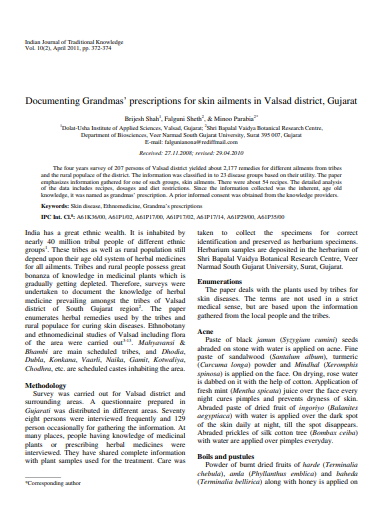
Documenting Grandmas’ Prescriptions for Skin Ailments in Valsad district, Gujarat
2011
Author(s): Shah B , Sheth F, Parabia M
The paper emphasizes information gathered for one of such groups, skin ailments.

Documentation of Folk Knowledge on Medicinal Plants of Gulbarga district, Karnataka
2011
Author(s): Ghatapanadi SR, Johnson N , Rajasab AH
The study is based on the indigenous knowledge of local traditional healers and the native plants used for medicinal purposes were collected through questionnaire and personal interviews.

A Methodological Framework for the Dynamic Conservation of Agricultural Heritage Systems
2011
Author(s): Koohafkan P, Altier M
The overall study is to identify and safeguard Globally Important Agricultural Heritage Systems and their associated landscapes, agricultural biodiversity and knowledge systems by initiating and establishing a long-term programme to support such systems and enhance global, national and local benefits derived from their dynamic conservation, sustainable management and enhanced viability.

Beekeeping and Sustainable Livelihoods Second Edition
2011
Author(s): Hilmi M, Bradbear N, Mejia D
The study aim to create awareness and promote beekeeping as a viable diversification enterprise for small-scale farmers. Its main objective is to demonstrate how beekeeping can become an important business for small-scale farmers in their agricultural endeavours and how this can support their livelihoods in rural and remote areas. The booklet is intended for all those working in rural development projects in public, private and donor organizations.

Indigenous ways of understanding and interacting with the natural world are characterized as Traditional Ecological Knowledge (TEK), which derives from emphasizing relationships and connections among species. This book examines TEK and its strengths in relation to Western ecological knowledge and evolutionary philosophy.