


Research Papers/Articles

Nature of Employment and Outcomes for Urban Labor: Evidence from the Latest Labor Force Surveys in India
2022
Author(s): Roy D, Saroj S, Pradhan M
The paper uniquely assess the extent of job turnovers for urban workers and falling into unemployment at high frequency based on TOE. Analysis of urban panel after accounting for unobserved worker level factors captures the extent of fall in income due to job switching and loss of employment. Results indicate significant potential for poverty if worker is not socially protected, engaged in distress entrepreneurship or as casual labor.
Traditional Agroecological Knowledge and Practices: The Drivers and Opportunities for Adaptation Actions in the Northern Region of Ghana
2022
Author(s): Yeleliere E, Yeboah T, Antwi-Agyei P, Peprah P
This paper analyzed traditional agroecological knowledge and practices and their adaptation opportunities to address climate change and promote the existence and sustainability of local innovation. It highlights traditional agroecological knowledge and practices drawn from the long-term experience and technical capabilities of smallholder farmers themselves.

Sweetgrass Method: A Culturally Responsive Approach among American Indian and Alaska Native K-12
2022
Author(s): Baez MSE,Baez CA,Lavallie B,Spears W
The Sweetgrass Method is a culturally responsive approach to mental health for American Indian/Alaska Native Youth and serves as a process to communicate, collaborate, and continue ongoing supports. The Sweetgrass Method is applied in practice as an approach that encourages culturally responsive methods and culturally sensitive therapies as significant approaches.
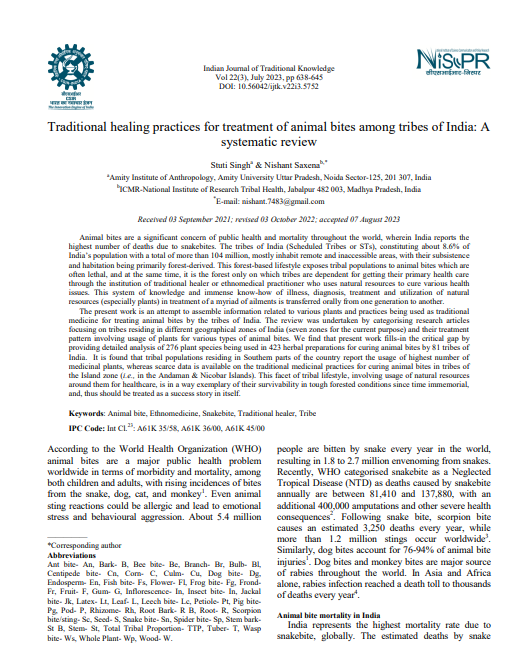
Traditional Healing Practices for Treatment of Animal Bites Among Tribes of India: A systematic review
2022
Author(s): Saxena N ,Singh S
The present work is an attempt to assemble information related to various plants and practices being used as traditional medicine for treating animal bites by the tribes of India. The review was undertaken by categorizing research articles focusing on tribes residing in different geographical zones of India (seven zones for the current purpose) and their treatment pattern involving usage of plants for various types of animal bites.

Legal Protection of Traditional Knowledge (Comparative Study of Bangladesh, Australia and Indonesia)
2022
Author(s): Wibowo A T T, Setiyono J
This paper discussed the comparison of traditional knowledge legal protection in several countries, such as Bangladesh, Australia and Indonesia. The research method used in this paper uses normative juridical.

Indigenous Oral Knowledge of Wild Medicinal Plants from the Peren District of Nagaland, India in the Indo Burma Hot-Spot
2022
Author(s): Jamir K, Seshagirirao K, Meitei MD
The study was carried out to document and create a link between the available oral tradition and the scientific knowledge in Peren district of Nagaland. It aims to harness indigenous knowledge of the tribals on the diverse medicinal plants of the region for their use in pharmacognosy through in-depth research.

Indigenous Peoples' Food Systems and Biocultural Heritage: Addressing Indigenous Priorities Using Decolonial and Interdisciplinary Research Approaches
2022
Author(s): Swiderska K, Argumedo A, Wekesa C, Ndalilo L, Song Y, Rastogi A, Ryan P
The paper presents a decolonial and interdisciplinary framework for action-research on Indigenous food systems past and present, from farm to plate, drawing on the virtual workshops, Andean decolonising methods and historical approaches. It concludes that decolonising action-research, led by Indigenous Peoples, is urgently needed to reverse the rapid loss of food-related biocultural heritage.
An Ethnobotanical Study of the Indigenous Knowledge by the Rajbangshi Community of Raiganj Block, Uttar Dinajpur District, West Bengal, India
2022
Author(s): Basak GK, Chowdhury T, Jana AK, Saha S, Mandal A
The present study deals with documentation of medicinal importance of plants and traditional knowledge set harboring among the ethnic communities to utilize various plant parts for various health care practices. Twelve villages were surveyed primarily targeting the Rajbangshi communities of Raiganj Block, Uttar Dinajpur district, West Bengal, India.

Role of Traditional Knowledge in the COVIDā€19 Battle
2022
Author(s): Ola K
This article addresses the role of traditional medicine in the corona virus (COVIDā€19) battle. The paper discusses the increased gravitation towards using traditional medicine but also identifies the existence of skepticism towards its use.
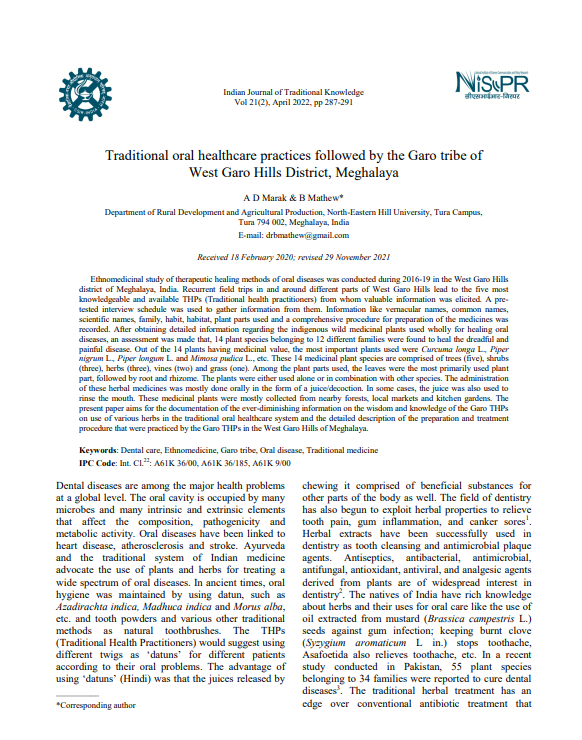
Traditional Oral Healthcare Practices Followed by the Garo Tribe of West Garo Hills District, Meghalaya
2022
Author(s): Marak AD, Mathew B
This paper revealed the ethnomedicinal study conducted in Meghalaya's West Garo Hills district between 2016 and 2019 uncovered 14 indigenous plant species, including Curcuma longa and Mimosa pudica, employed by Traditional Health Practitioners to heal oral diseases.