


Knowledge Hub

Medicinal Plants Use in Traditional Healthcare Systems Prevalent in Western Himalayas
2006
Author(s): Kanwar P , Sharma N , Rekha A
The present research work was carried out in six villages of Kangra district of Himachal Pradesh to study application of plants at home scale level in treating various kinds of ailments.

Plant Indicators for Agricultural Seasons Amongst Pnar Tribe of Meghalaya
2006
Author(s): Samati H, Begum SS
The work relates to Pnar tribe of Jaintia Hills district, Meghalaya, whose main occupation is agriculture. Even today they depend on plant species as indicators, such as Butea buteiformis (Voigt) Grier. & Long, Castanopsis indica A. DC., Castanopsis tribuloides (Sm.) DC., Phoenix humilis Royle ex Becc. & Hook. f., Pinus kesiya Royle ex Gord., Quercus serrata Thunb., Schima wallichii (DC.) Korth. for systematizing steps they followed season wise for achieving the best productivity of rice and other agricultural crops.

Traditional Knowledge and Biodiversity Conservation in the Sacred Groves of Meghalaya
2006
Author(s): Jeeva S , Mishra BP , Venugopal N ,Kharlukhi L, Laloo RC
This study shows how the Meghalaya Sacred Groves are considered to be the most species-rich areas for plants, birds and mammals. The mythological stories and indigenous knowledge associated with the groves have been the principal factor in preserving the sacred groves in the immaculate condition.

Climate Variability and Climate Change in Southern Africa:Impacts and Adaptation in the Agricultural Sector
2006
Author(s): Kandji ST , Verchot L, Mackensen J
The aim of this study is simply to take stock of the existing knowledge that could be useful in the formulation of adaptation strategies geared at improving the resilience of the rural communities in southern Africa, who depend heavily on agriculture for their livelihood.

This paper summarises the salient conclusions of the three STAP studies and draws lessons and recommendations for Global Environment Facility(GEF) in further developing its strategic approach to the Land Degradation Focal Area(LD FA) and guiding future investments in sustainable land management (SLM) in order to address gaps in the scientific knowledge and areas where investments will achieve greatest global environmental benefit.
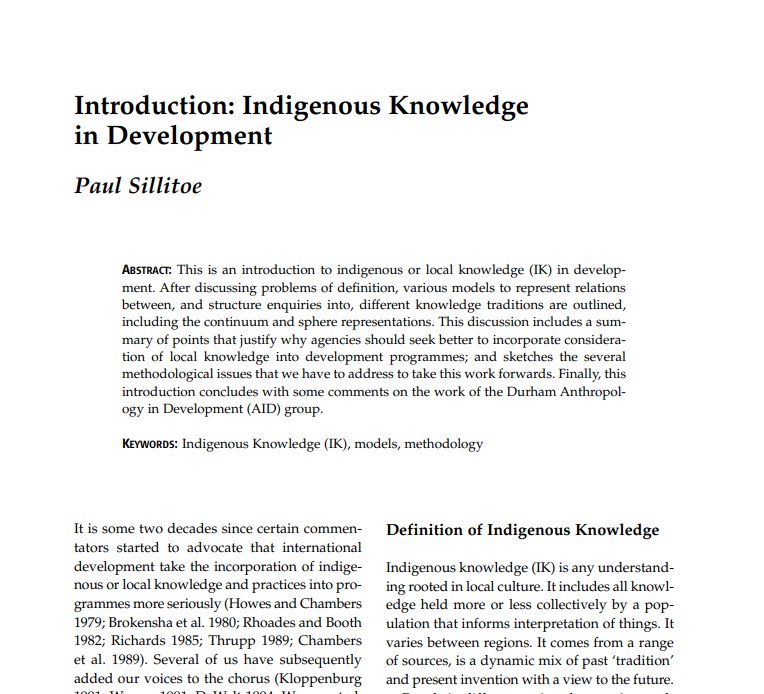
Introduction: Indigenous Knowledge in Development
2006
Author(s): Sillitoe P
This discussion includes a summary of points that justify why agencies should seek to incorporate local knowledge into development programmes; and sketches the several methodological issues that to address to take this work forward.

Herbal Remedies Used for Haemorrhoids by Tribals of Saurashtra, Gujarat
2006
Author(s): Jadeja BA , Odedra NK , Odedra KR
In the present paper, 94 plant species belonging to 82 genera and 52 families used by the indigenous people for the treatment of haemorrhoids have been described.
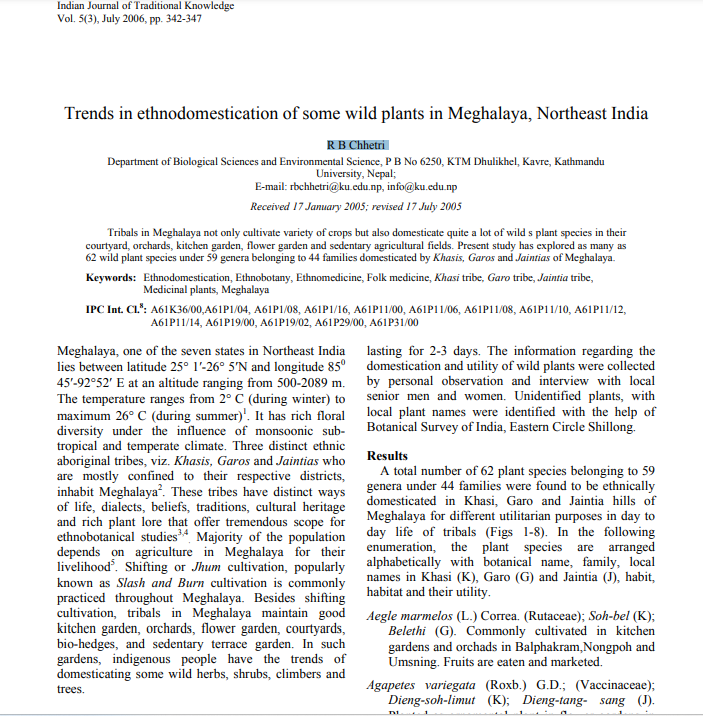
Trends in Ethnodomestication of Some Wild Plants in Meghalaya, Northeast India
2006
Author(s): Chhetri R B
Tribals in Meghalaya not only cultivate variety of crops but also domesticate quite a lot of wild s plant species in their courtyard, orchards, kitchen garden, flower garden and sedentary agricultu...

Cultural Significance and Diversities of Ethnic Foods of Northeast India
2006
Author(s): Singh A, Singh RK, Sureja AK.
This paper to explore the ethnic foods made of local soybean, bamboo shoot, tree bean, lai patta (leafy mustard) and rai (Brassica juncea (Linn.) Czern. & Coss.) from different selected tribes of Northeast India.

Approaches in Documenting Ethnoveterinary Practices
2006
Author(s): Tripathi H
This paper attempts to draw attention to the research, development and the extension workers to take due cognizance of the knowledge possessed by them their contribution and potential, competencies and capabilities to explore fully for deriving real benefits for the animal sector.