


Research Papers/Articles

Documenting the Agriculture Based Indigenous Traditional Knowledge in Manipur State of North Eastern India.
2021
Author(s): Ansaria M A, Sharmaa S K, Roya S S, Ramakrishnab Y, Dattc S, Ningombama A, AjitSinghb N A, Luiramb S, Prakasha N.
The paper is based on documentation of various Traditional Knowledge practice by the people in the State of Manipur, India. This work will serve as a way of preservation and conservation of Traditional Knowledge
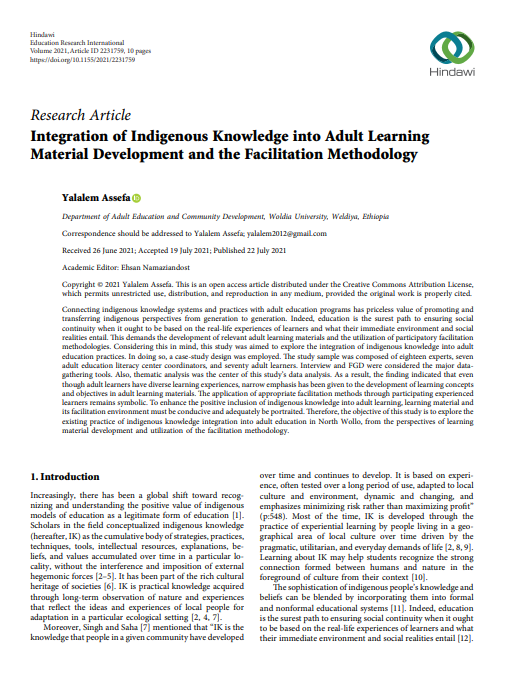
Integration of Indigenous Knowledge into Adult Learning Material Development and the Facilitation Methodology
2021
Author(s): Namaziandost E , Assefa Y
The objective of this study is to explore the existing practice of indigenous knowledge integration into adult education in North Wollo, from the perspectives of learning material development and utilization of the facilitation methodology.

Herbal-Based Drugs for Dry Eye; Treatment and Adverse Reactions
2021
Author(s): Reyhani M, Aghamollaei H, Jadidi K, Barzegar A
This study shows that some herbal products have the potential to be used for the treatment of dry eye while the use of certain products can lead to this syndrome.

Fishing Techniques and Gears Developed by Tribal Communities Around Bargi Reservoir in Madhya Pradesh, India
2021
Author(s): Rasal V, Dasgupta S,Yadre S, Shukla SP
Traditional knowledge (TK) plays a very important role in the lives of millions of people around the world. There is an immense need for documentation of traditional knowledge especially in countries rich in biodiversity, such as India. Bargi is one of the major dams constructed on the river Narmada in Madhya Pradesh. Local communities have used various fishing methods since time immemorial.
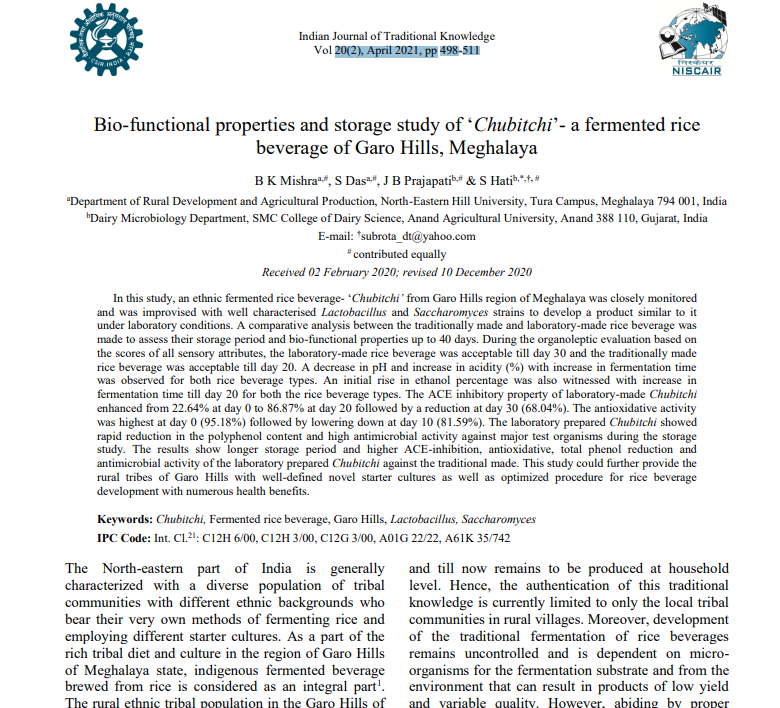
Bio-Functional Properties and Storage Study of ‘Chubitchi’- A Fermented Rice Beverage of Garo Hills, Meghalaya
2021
Author(s): Mishra BK, Das S,Prajapati JB,Hati S
In this study, an ethnic fermented rice beverage- ‘Chubitchi’ from Garo Hills region of Meghalaya was closely ¬¬¬-monitored and was improvised with well characterised Lactobacillus and Saccharomyces strains to develop a product similar to it under laboratory conditions.

Traditional Uses of Multi-cob Bearing Murlimakai Primitive Maize Landrace from Sikkim State, India
2021
Author(s): Babua PK, Rai D
This study shows that Multi-cob baring murlimakai is used for various purposes such as mouthwatering delicious foods preparation such as popcorn, chapati, roti, chyakdung. Makkaiko chamal, makkaiko pitho, makkaiko laddu and makkaiko dalla.

Understanding the Application and Use of Indigenous Research Methodologies in the Social Sciences by Indigenous and Non-Indigenous Scholars
2021
Author(s): Pidgeon M , Riley T
Research partnerships with Indigenous communities are relationships with cultural expectations of responsibility, relevance, and respect for Indigenous knowledge, goals, and aspirations. Indigenous communities have been seeking access to and ownership, control, and possession of research in their communities ever since “researchers” came to their lands (Brant Castellano, 2004; Wilson, 2008)

Nutritional And Anti-Nutritional Analysis of Wild Edible Plants in Hassan District of Karnataka, India
2021
Author(s): Kumar GMP, Shiddamallayya N
The nutritional potential of twelve wild edible plants of Hassan district was botanically identified and analysed for their nutritional and antinutritional values. The present study showed that the crude protein varied from 0.26±0.05 g/100 g to 5.88±0.55 g/100 g for different plant species.

The Practice of Using Medicinal Plants by Local Herbalists in Cavite, Philippines
2021
Author(s): Caunca ES , Balinado LO
This study was conducted to document this oral tradition which is threatened to be lost due to rapid urbanization. This paper aims to provide a documentation of the local knowledge and practices on medicinal plant utilization in the urban province of Cavite, Philippines.
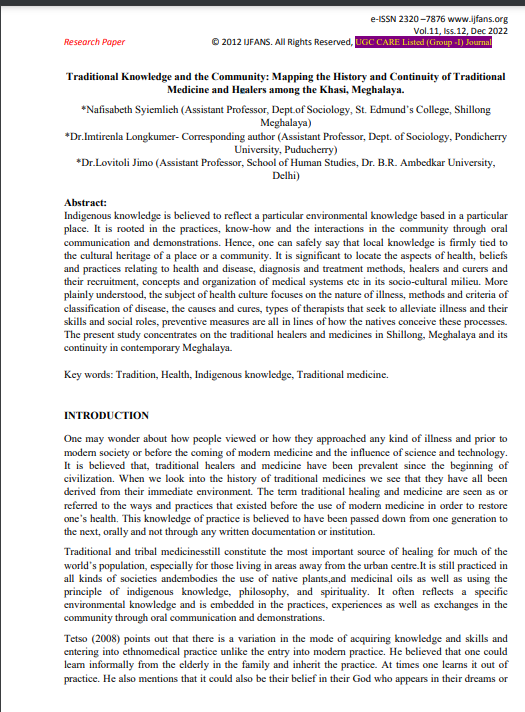
Traditional Knowledge and the Community: Mapping the History and Continuity of Traditional Medicine and Healers among the Khasi, Meghalaya.
2021
Author(s): Syiemlieh N, Longkumer I, Jimo L
The present study concentrates on the traditional healers and medicines in Shillong, Meghalaya and its continuity in contemporary Meghalaya. Traditional and tribal medicines still constitute the most important source of healing for much of the world's population, especially for those living in areas away from the urban centre .It is still practiced in all kinds of societies and embodies the use of native plants, and medicinal oils as well as using the principle of indigenous knowledge, philosophy, and spirituality