


Research Papers/Articles
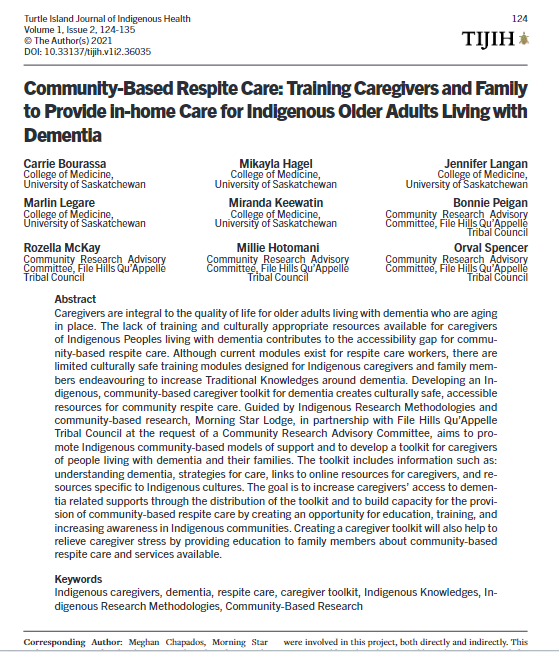
Community-Based Respite Care: Training Caregivers and Family to Provide in-home Care for Indigenous Older Adults Living with Dementia
2021
Author(s): Bourassa C, Hagel M, Langan J, Legare M, Keewatin M, Peigan B, McKay R, Hotomani M, Spencer O
The toolkit includes information such as: understanding dementia, strategies for care, links to online resources for caregivers, and resources specific to Indigenous cultures. The goal is to increase caregivers’ access to dementia related supports through the distribution of the toolkit and to build capacity for the provision of community-based respite care by creating an opportunity for education, training, and increasing awareness in Indigenous communities. Creating a caregiver toolkit will also help to relieve caregiver stress by providing education to family members about community-based respite care and services available.
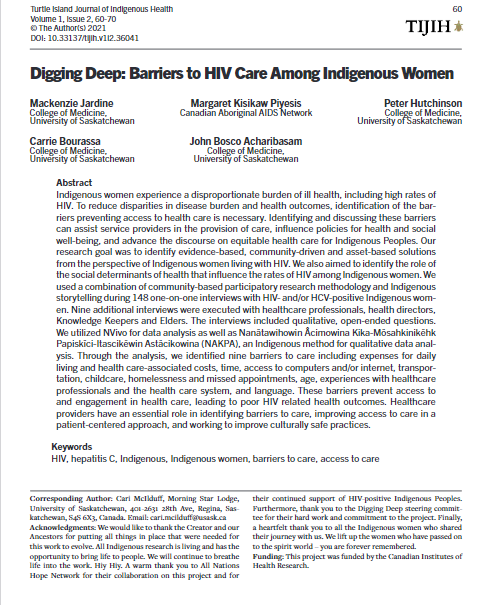
Digging Deep: Barriers to HIV Care Among Indigenous Women
2021
Author(s): Jardine M, Bourassa C, Piyesis MK
Through the analysis, it has been identified nine barriers to care including expenses for daily living and health care-associated costs, time, access to computers and/or internet, transpor-tation, childcare, homelessness and missed appointments, age, experiences with healthcare professionals and the health care system, and language. These barriers prevent access to and engagement in health care, leading to poor HIV related health outcomes. Healthcare providers have an essential role in identifying barriers to care, improving access to care in a patient-centered approach, and working to improve culturally safe practices
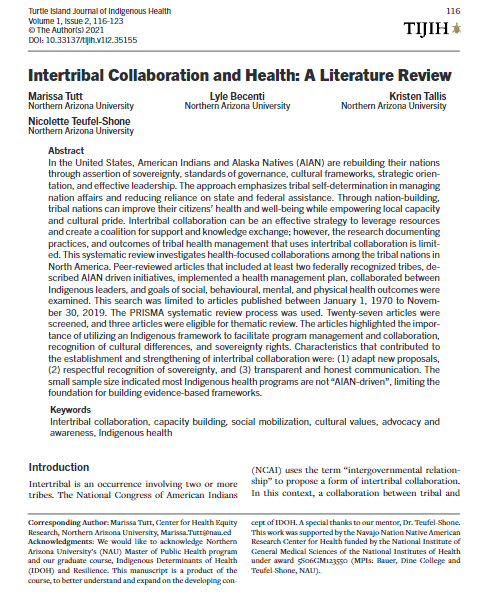
Intertribal Collaboration and Health: A Literature Review
2021
Author(s): Tutt M, Becenti L, Tallis K, Shone NT
This search was limited to articles published between January 1, 1970 to November 30, 2019. The PRISMA systematic review process was used. Twenty-seven articles were screened, and three articles were eligible for thematic review. The articles highlighted the importance of utilizing an Indigenous framework to facilitate program management and collaboration, recognition of cultural differences, and sovereignty rights. Characteristics that contributed to the establishment and strengthening of intertribal collaboration were: (1) adapt new proposals, (2) respectful recognition of sovereignty, and (3) transparent and honest communication. The small sample size indicated most Indigenous health programs are not “AIAN-driven”, limiting the foundation for building evidence-based frameworks.
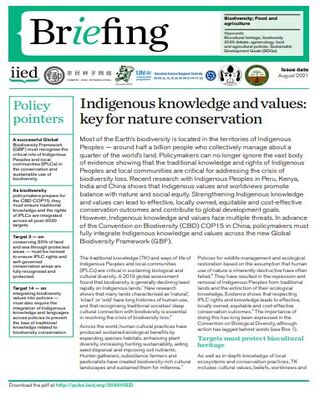
Indigenous knowledge and values: key for nature conservation
2021
Author(s): Swiderska K, Argumedo A, Song Y, Rastogi A, Gurung N, Wekesa, C, Li G
This research shows that, across different Indigenous cultures, TK enshrines core values of balance, reciprocity and solidarity with nature and in society that provide flexible principles for sustainable and equitable development. These can be strengthened as the basis for community owned, equitable and self-sustaining conservation and development initiatives, such as biocultural heritage territories.

Indigenous Oromo Gadaa System vis-à-vis Peace Building from Below Approach
2020
Author(s): Fituma D
This paper is intended to address why indigenous concepts matter in today’s peace building processes, and to explain the Oromo Gadaa system with respect to peace building from below point of view.The paper concludes that, the indigenous Oromo world view based on the Gadaa system deals with peace building process in broader and holistic ways than the way it is experienced at different corners.

Indigenous Knowledge on Climate Change Adaptation: A Global Evidence Map of Academic Literature
2020
Author(s): Petzold J, Andrews N, Ford JD, Hedemann C, Postigo JC
The study provides an overview of the evidence of indigenous knowledge for adaptation across regions and categorises relevant concepts related to indigenous knowledge and their contexts in the climate change literature across disciplines.

Designing Indigenous Knowledge Management Model for Gadaa System: Rule-based Knowledge Representation Approach
2020
Author(s): Tadele T,Muda J,Abas S
This paper analyzes the current status of indigenous knowledge (IK) in Gadaa System in Oromo as general and Guji Oromo Community in specific, and the way how IK has been transferred among Guji Oromo Community for the long period of time, and indicating the way forward on capturing, converting, sharing and preserving the IK in Gadaa System for the next generation with the help of Technology.
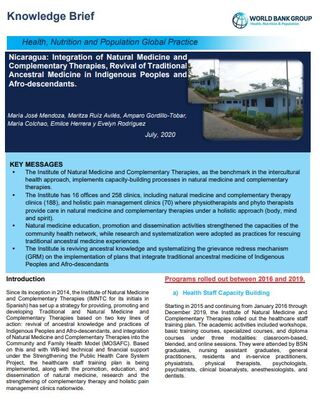
Nicaragua: integration of natural medicine and complementary therapies, revival of traditional ancestral medicine in indigenous peoples and Afro-descendants.
2020
Author(s): Mendoza MJ, Avilés MR, Gordillo-Tobar A, Colchao M, Rodríguez EHE
The brief highlights the initiative of The Institute of Natural Medicine and Complementary Therapies in reviving traditional ancestral medicine among Indigenous Peoples and Afro-descendants in Nicaragua.
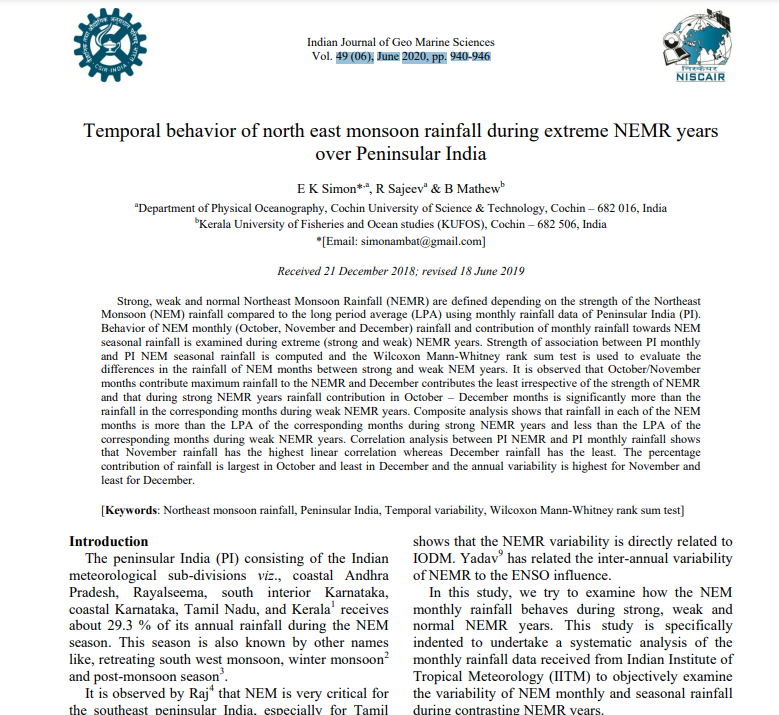
Temporal Behavior of North East Monsoon Rainfall During Extreme NEMR Years Over Peninsular India
2020
Author(s): Simon EK, Sajeev R, Mathew B
Strong, weak and normal North East Monsoon Rainfall (NEMR) are defined depending on the strength of the Northeast Monsoon (NEM) rainfall compared to the long period average (LPA) using monthly rainfall data of Peninsular India (PI). Behavior of NEM monthly (October, November and December) rainfall and contribution of monthly rainfall towards NEM seasonal rainfall is examined during extreme (strong and weak) NEMR years.

Measuring Regional Ethnolinguistic Diversity in Sub-Saharan Africa: Surveys versus GIS
2020
Author(s): Gershman B, Rivera D
This paper compares two approaches to measuring subnational ethnolinguistic diversity in Sub-Saharan Africa, one based on censuses and large-scale population surveys and the other relying on the use of geographic information systems (GIS).