


Knowledge Hub

Ecocriticism and Indigenous Studies: Conversations from Earth to Cosmos
2020
Author(s): Monani S, Adamson J
This book addresses the intersections between the interdisciplinary realms of Ecocriticism and Indigenous and Native American Studies, and between academic theory and pragmatic eco-activism conducted by multiethnic and indigenous communities. It illuminates the multi-layered, polyvocal ways in which artistic expressions render ecological connections, drawing on scholars working in collaboration with Indigenous artists from all walks of life, including film, literature, performance, and other forms of multimedia to expand existing conversations.

The Status and Prospectus of Fisheries and Aquaculture in Maharashtra, India
2020
Author(s): Bhendarkar MP,Brahmane MP,Gaikwad BB & Singh NP
Fisheries and aquaculture sector has witnessed rapid development across the states of India and has paved way for income generation and livelihood for associated rural and urban communities. Maharashtra state ranks 7th with around 5 % share in country’s fish production, is yet to explore its untapped potential completely.

The book systematically applies a human capital approach to educational policy, to help understand the education and broader development outcomes of indigenous peoples.

Cultural Competence and the Higher Education Sector: Australian Perspectives, Policies and Practice
2020
Author(s): Frawley J, Russell G, Sherwood J
This book explores cultural competence in the higher education sector from multi-disciplinary and inter-disciplinary perspectives. It addresses cultural competence in terms of leadership and the role of the higher education sector in cultural competence policy and practice.
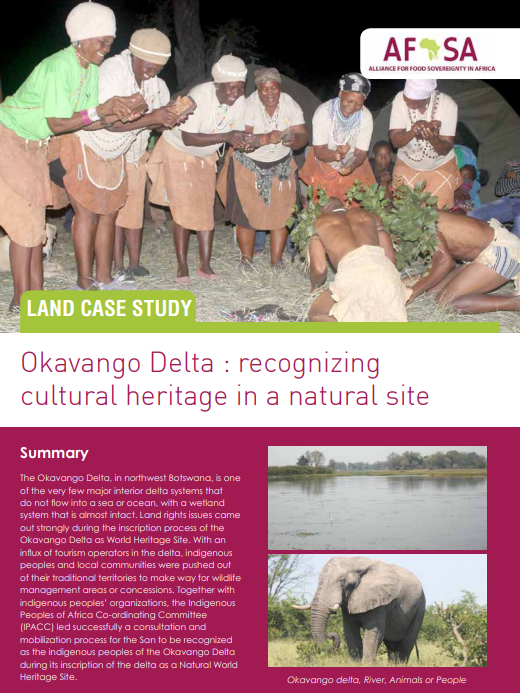
Okavango Delta : Recognizing Cultural Heritage in a Natural Site
2020
Author(s): Andrias LM
Indigenous peoples’ organizations, the Indigenous Peoples of Africa Co-ordinating Committee (IPACC) led successfully a consultation and mobilization process for the San to be recognized as the indigenous peoples of the Okavango Delta during its inscription of the delta as a Natural World Heritage Site.

Free, Prior and Informed Consent: A Successful Process of Dialogue and Co-Decision-Making With and For Panama’s Indigenous Peoples
2020
Author(s): Food and Agriculture Organization of the United Nations
In this context, FAO is executing a project to support 19 communities belonging to six of the seven existing indigenous peoples in the country, which is financed by the Ministry of Government (MINGOB), with the support of the Ministry of Agricultural Development (MIDA) and the participation of the 12 indigenous congresses and councils.

This book outlines development theory and practice over time as well as critically interrogates the “cultural turn” in development policy in Latin American indigenous communities, specifically, in Guatemala, Honduras, Ecuador, and Bolivia.
Protection of Traditional Knowledge: The Work and the Role of International Organisations and Conferences
2020
Author(s): Gazizova AS
It is noted that today, at the international level, there are no instruments that ensure comprehensive protection of traditional knowledge. The author concludes that WIPO and UNESCO currently carry out the main work aimed at providing the protection of traditional knowledge. However, other international organizations and conferences, such as WHO, WTO, FAO, UNCTAD and Conference of the Parties of CBD in their work are also addressed some aspects associated with the preservation of traditional knowledge.

COVID-19 and The World of Work: A Focus on Indigenous and Tribal Peoples
2020
Publisher/Organisation: International Labour Organization
Drawing on new ILO data, this brief analyses the vulnerabilities of indigenous and tribal peoples in the COVID-19 context and identifies urgent and continuing actions to ensure their access to decent work and social protection, as part of the unfolding COVID-19 response and recovery. Highlighting relevant international labour standards and the importance of social dialogue for advancing solutions, the brief also underlines that state institutions for indigenous and tribal peoples’ participation and consultation are essential for building pathways to resilience and sustainable development that leave no one behind.
Implementing the ILO Indigenous and Tribal Peoples Convention No. 169: Towards an Inclusive, Sustainable and Just Future
2020
Author(s): Dhir RK
Educational inequalities are a fundamental barrier for indigenous peoples – almost 47 per cent of indigenous adults in employment have no education compared to 17 per cent of non-indigenous adults. There are over 476 million indigenous peoples globally constituting over 6 percent of the world’s population.