



Research Papers/Articles

Culture and Biodiversity Conservation: Case studies from Uttarakhand, Central Himalaya
2012
Author(s): Negi CS
The present study deals with the study of sacred natural sites (forests/groves, pastures, water bodies) along with the phenomenon of dedication of the forests to a deity, and the inherent taboos with regard to the resource exploitation and other traditional beliefs and customs being practiced in the Central Himalaya, and attempts to bring out the inherent environmental principles behind these practices.

Phytochemical Screening and Antibacterial Activity of Selected Medicinal Plants of Bayabas, Sablan, Benguet Province, Cordillera Administrative Region, Luzon, Philippines
2012
Author(s): Balangcod TD, Vallejo VL, Patacsil M , Apostol O
This study provides scientific basis for the ethno-botanical knowledge of the local community. The phytochemicals of the plants when developed further, can offer a less-expensive treatment for various ailments.

Traditional Textiles and Costumes of Karbi and Biate Tribes of Meghalaya
2012
Author(s): Karolia A, Ladia B
The objectives of the study were to document the yarns, looms, colors, motifs and costumes worn for different occasions. Data was gathered through personal interviews coupled with observation method from purposive selected samples and photographs were taken to support the study.

Biotechnology in Tradition – A Process Technology of Alcoholic Beverages Practiced by Different Tribes of Arunachal Pradesh, North East India
2012
Author(s): Shrivastava K, Greeshma AG, Srivastava B
North eastern region of India in general and Arunachal Pradesh in particular is well known for their age old practice of preparation of alcoholic fermented beverages.

Improving Agricultural Knowledge and Innovation Systems: OECD Conference Proceedings
2012
Author(s): Organization for Economic Cooperation and Development
This conference proceedings from the OECD Conference on Agricultural Knowledge Systems (AKS), held in Paris, on 15-17 June 2011, discusses a large range of experiences and approaches to AKS explores how to foster development and adoption of innovation to meet global food security and climate change challenges. The conference considered developments in institutional frameworks, public and private roles and partnerships, regulatory frameworks conducive to innovation, the adoption of innovations and technology transfers, and the responsiveness of AKS to broader policy objectives.

Wild Edible Fungal Resources Used by Ethnic Tribes of Nagaland, India
2011
Author(s): Bhaben T,Gurung L,Chandra SG
The paper documents the knowledge about the wild edible fungal flora of Kohima district of Nagaland, India used by the indigenous tribes through structured questionnaires in consultations.

Cultural Values and Indigenous Knowledge of Climate Change and Disaster Prediction in Rajasthan, India
2011
Author(s): Pareek A, Trivedi PC
This paper provides a case study in which Indigenous knowledge and traditional stories relating to cloud formation, lightning, wind direction, rains, drought, disaster prediction, response, mitigation, and effects of weather on crops are applied in a contemporary context by the tribal peoples of Rajasthan, India.

Indigenous Women Entrepreneurs in Papua GET Ahead
2011
Author(s): International Labour Organization
Like many other women who live in a patriarchal society, the indigenous women of Papua do not have many opportunities to take part in the development process. Their traditionally low status in the tribal hierarchy and poor education make them second-class members of society who have to occupy themselves with food and children, and serve their husbands.
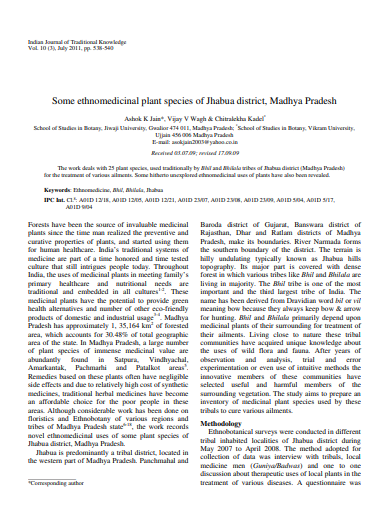
Some Ethnomedicinal Plant Species of Jhabua district, Madhya Pradesh
2011
Author(s): Jain AK, Wagh VV, Kadel C
The work deals with 25 plant species, used traditionally by Bhil and Bhilala tribes of Jhabua district (Madhya Pradesh) for the treatment of various ailments.

Plants Used as Agricultural Seasons Indicator By Mao Naga tribe, Manipur, India
2011
Author(s): Mao AA, Hynniewta MT
The paper presents four plants used as an agricultural season indicator by Mao Naga tribe of Manipur, India. Agriculture is the main occupation of the tribe and they have a unique way of knowing plantation season for different crops by observing the flowering of some plants.