


Knowledge Hub
Ethno-medico Botanical Study of Indigenous Knowledge on Medicinal Plants Used For The Treatment of Reproductive Problems in Nalbari District, Assam, India.
2018
Author(s): Adhikari PP, Talukdar S, Borah A.
This documentation research work aims to explore the biological and pharmacological properties of the local name of the medicinal plants used by both male and female from indigenous knowledge for the treatment of reproductive ailments and also for confirmation and to address the class of secondary metabolites present therein.
Studying an Indigenous Rainwater Harvesting System in Banni Grassland of Kachchh, India
2018
Author(s): Machiwal D, Kumar S, Sharma GK , Jat SR, Dayal D
This study focuses on an indigenous rainwater harvesting system, locally known as virda that was evolved centuries ago in Banni grassland of Kachchh, Gujarat, India.
Clinical Relevance and Application of Traditional Complementary and Alternative Medicine for the Management of Diabetes and Hypertension on the African Continent, 2000-2017: A Narrative Review
2018
Author(s): Frimpong E, Nlooto M
The aim of this study was to find clinical relevance and use of TCAM in the management of diabetes and hypertension on the African continent. To achieve our aim Google scholar, web of science, Pub-med and Cochrane library electronic databases were searched for the period 2000-2017 using specific keywords related to the study.
Wild Edible Plants and their Traditional Use in the Human Nutrition in Manyas (Turkey)
2018
Author(s): Kayabaş NP, Tümen G, Polat R
The study showed that the plants used are either eaten raw, or cooked by boiling in water, frying in oil, baked to be served as dishes such as stew, salad as hot drink.
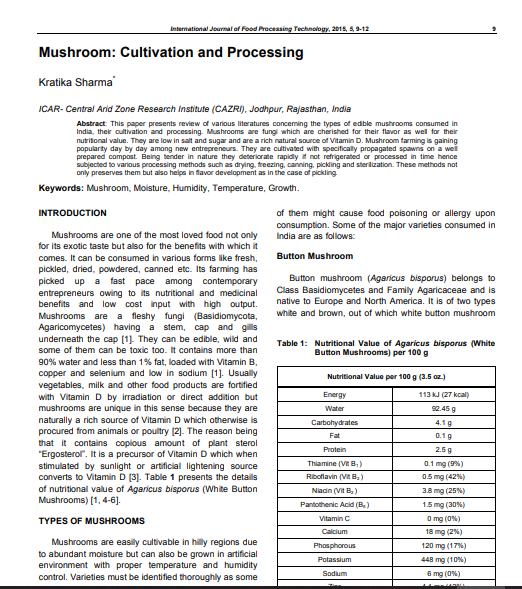
This paper presents review of various literatures concerning the types of edible mushrooms consumed in India, their cultivation and processing. Mushroom farming is gaining popularity day by day among new entrepreneurs.
Smallholder farming systems in the Indian Himalayas: key trends and innovations for resilience
2018
Author(s): Mukerjee P, Sogani R, Gurung N, Rastogi A, Swiderska K
Traditional farmers in the Central and Eastern Indian Himalayas have observed significant climatic changes in recent years, reducing agricultural productivity. They have responded by innovating to increase resilience and yields, using traditional knowledge, biodiversity and external knowledge. This report explores key trends in livelihoods, food security, crop diversity and biocultural heritage across ten communities; the biocultural innovations developed in response to climatic and socioeconomic changes; and the social factors that have supported biocultural innovation.
Traditional Knowledge and Heirloom Root Vegetables: Food Security in Trans-Himalayan Ladakh, India
2018
Author(s): Chorol S , Angchok D, Angmo P , Tamchos T, Singh RK
This study elaborates the role of heirloom vegetables coming down from generations to generations into the life support system of native Ladakhi highlanders (in the trans-Himalaya region of India).
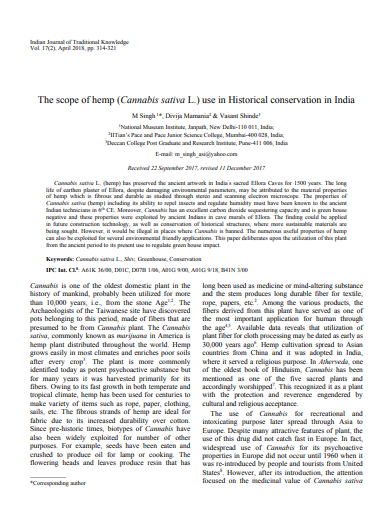
The Scope of Hemp (Cannabis sativa L.) Use in Historical Conservation in India
2018
Author(s): Singh M, Mamania D, Shinde V
This paper deliberates upon the utilization of Cannabis sativa L. (hemp) plant from the ancient period to its present use to regulate green house impact.
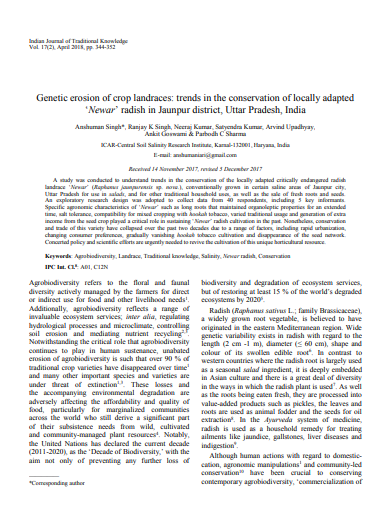
Genetic Erosion of Crop Landraces: Trends in the Conservation of Locally Adapted ‘Newar ’ Radish in Jaunpur District, Uttar Pradesh, India
2018
Author(s): Singh A, Singh RK, Kumar N, Kumar S
A study was conducted to understand trends in the conservation of the locally adapted critically endangered radish landrace ‘Newar ’ (Raphanus jaunpurensis sp. nova.), conventionally grown in certain saline areas of Jaunpur city, Uttar Pradesh for use in salads, and for other traditional household uses, as well as the sale of fresh roots and seeds.
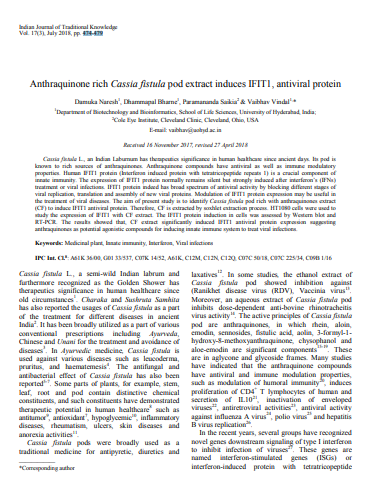
Anthraquinone Rich Cassia Fistula Pod Extract Induces IFIT1, Antiviral Protein
2018
Author(s): Naresh D, Bharne D , Saikia P, Vindal V
The aim of present study is to identify Cassia fistula pod rich with anthraquinones extract (CF) to induce IFIT1 antiviral protein. Therefore, CF is extracted by soxhlet extraction process.