


Research Papers/Articles

Isolation of Colour Component from the Roots of Morinda angustifolia Roxb. and Evaluation of its Dyeing Characteristics
2002
Author(s): Bhuyan R , Saikia DC, Saikia CN
The study is based on the colour component in the roots of the plant Morinda angustifolia which has been isolated and its chemical structure established on the basis of chemical and spectroscopic studies.

Technology Transfer for Agriculture Growth in Africa
2002
Author(s): Moussa S Z
The paper discusses the challenges for agricultural growth and evaluates the development assistance that was made by donors to the agricultural sector in Africa in comparison to the sector’s performance and its growth during the last two decades.

Bioaccumulation of Neem Limonoids in Pleurotus sajor-caju
2001
Author(s): Dolt KS , Reddy GV, Shah MP, Kunjadia PD, Kothari IL
This study is to find out the intensity of accumulation of medicinally important limonoids in the fruiting bodies through HPLC, Azadirachtin, one of the limonoids, is taken as a reference compound and it is found to he accumulated in the fruiting bodies of P sajor-caju

The aim of this study is to show that the policy debate has proceeded largely in abstraction, with little regard to two key questions of fact: To what extent does indigenous knowledge actually get into the commercial patent system? Are the same kinds of entities responsible for the original research in indigenous communities and for patent-protected commercialization of the leads gained from community-level research?

Contributions of Traditional Knowledge to Understanding Climate Change in the Canadian Arctic
2001
Author(s): Jolly D
The paper discusses five areas in which traditional knowledge may complement scientific approaches to understanding climate change in the Canadian Arctic.

Traditional Knowledge of Indigenous and Local Communities: International Debate and Policy Initiatives
2000
Author(s): Mauro F, Hardison PD
This paper reviews international law and policy regarding the rights of indigenous peoples and local communities that are defining the role of traditional and indigenous knowledge in the management and conservation of biodiversity.
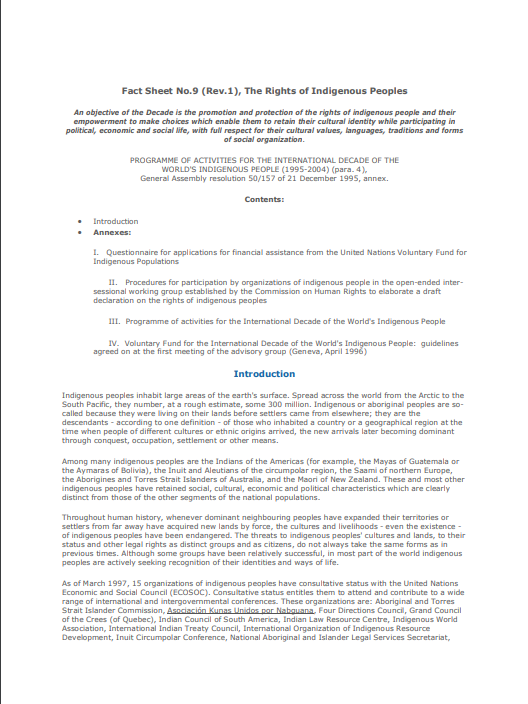
An objective of the Decade is the promotion and protection of the rights of indigenous people and their empowerment to make choices which enable them to retain their cultural identity while participating in political, economic and social life, with full respect for their cultural values, languages, traditions and forms of social organization