


Research Papers/Articles
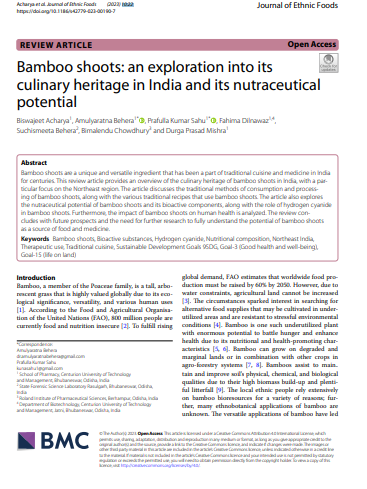
Bamboo Shoots: An Exploration Into Its Culinary Heritage in India and Its Nutraceutical Potential
2023
Author(s): Acharya B , Behera A, Kumar P , Dilnawaz F, Behera S
The article discusses the traditional methods of consumption and processing of bamboo shoots, along with the various traditional recipes that use bamboo shoots.
Indigenous Knowledge Systems and Drought Preparedness in Rural Umzingwane in Zimbabwe
2023
Author(s): Mandiopera WD, Ndlovu T, Kai G
The study found that IKS informs early detection of drought and response strategies in rural Umzingwane. In predicting drought hazards, communities rely on observing animal behaviour, fruiting of trees and growth of certain species in certain seasons.

Cross-Sectional Ethnobotanical Survey of Plants Used by Traditional Health Practitioners for Snakebite Case Management in Two Regions of Burkina Faso
2023
Author(s): Bamogo R, Nikièma AS, Belem M, Thiam M, Diatta Y, Dabiré RK
This study aimed to identify medicinal plants used by traditional healers in the Hauts-Bassins and Southwest regions of Burkina Faso to manage snakebite cases and repel snakes.
Traditional Medicines of the Himalayan Region: Anti-Dermatophytic Potential and Mode of Action of Isolated Compounds
2023
Author(s): Bibi R, Adnan M, Tariq A, Mussarat S, Andaleeb R, Khan AUR
The aim of the present review is to compile fragmented literature on ethnodermatology, anti-dermatophytic activities of the Himalayan flora, their active phytoconstituents and to discover gaps in the research for further studies that may provide targeted drug development.
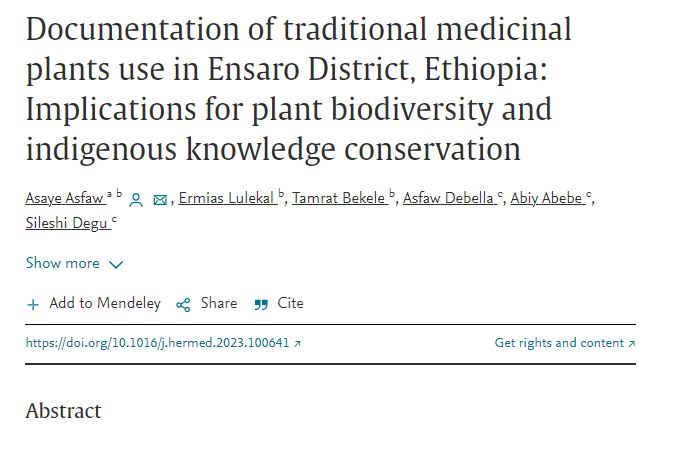
Documentation of traditional medicinal plants use in Ensaro District, Ethiopia: Implications for plant biodiversity and indigenous knowledge conservation
2023
Author(s): Asfaw A, Lulekal E, Bekele T, Debella A, Abebe A, Degu S
This study was conducted in Ensaro District in Ethiopia to identify medicinal plant species used by the local community to treat various human ailments. A total of 389 informants (283 males and 106 women) were chosen to collect ethnobotanical data. Semi-structured interviews, participant observation, guided field walks, and focus group discussions were used to collect ethnobotanical data.
Harnessing Indigenous Knowledge and Practices for Effective Adaptation in the Sahel
2023
Author(s): Zougmoré R, Alcade C Segnon AC, Thornton P
This review highlights the importance of indigenous knowledge in enabling effective adaptation in the Sahel and beyond. It outlines some future research avenues for fostering indigenous knowledge-based adaptation, including addressing barriers to mainstreaming of indigenous knowledge into climate research and policy.
Experiences and Insights on Bridging Knowledge Systems Between Indigenous and Non-Indigenous Partners: Learnings from the Laurentian Great Lakes
2023
Author(s): Stirling K M, Almack K, Boucher N, Duncan A, Muir A M, Connoy J W H, Gagnon V S, Lauzon R J, Mussett K J, Nonkes C, Vojno N, Reid A J
This article is a curation of insights and experiences shared during the virtual talking circle held during the “Bridging Knowledge Systems between Indigenous and non-Indigenous communities” session at the 2021 Annual Conference of the International Association for Great Lakes Research.

Indigenous Sports of India: Connecting Past to the Present
2023
Author(s): Jacob M, Nandini B, Sharma N
This study analysis in-depth about the various indigenous sports and their spread in India. It bridges the gap of lack of literature on indigenous sports in India.
Commercially Important Medicinal Plants of North East India and Their Current Applications: A Review
2023
Author(s): Dutta AK, Dutta PP, Pathak B , Barman D, Baruah P, Devi D
The present study has compiled and enlisted the wide range of medicinal plants used by different ethnic communities along with the highly traded medicinal and endemic plant species of superior quality attributes in the region.
Weaving the Links: Traditional Knowledge into Modern Science
2023
Author(s): Ray S
This paper provides the perspectives of the web links from an Indigenous world and the modern science view. Integrating the Indigenous knowledge into modern science and addressing the gaps in the traditional knowledge for science-policy assessments should be set as a high priority.