


Knowledge Hub
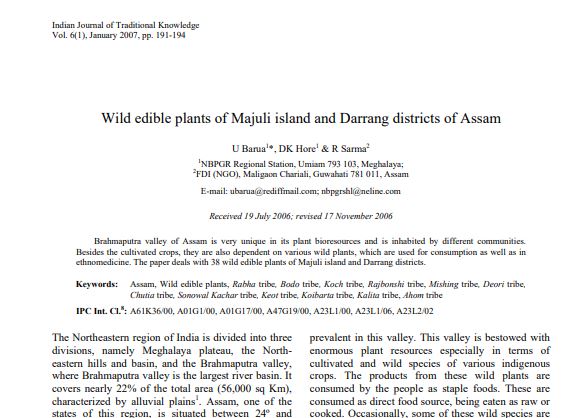
Wild Edible Plants of Majuli Island and Darrang Districts of Assam
2007
Author(s): Barua U , Hore DK, Sarma R
The paper deals with 38 wild edible plants of Majuli island and Darrang districts.

This publication focuses on the present scope and trends of international policies and activities related to the protection and preservation of traditional knowledge. The publication is based on a series of educational events organized and conducted by LIENIP.

Ethnomedicinal Uses of Barks in Jalgaon District
2007
Author(s): Pawar S , Patil D A
This paper reports their botanical identity, family, local names, parts used, preparations and doses, if any. It was observed that tribal people use barks of various trees in the form of decoction, infusion, extract, paste, poultice, powder, etc.
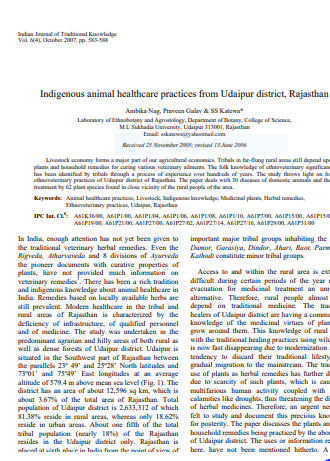
Indigenous Animal Healthcare Practices from Udaipur District, Rajasthan
2007
Author(s): Nag A, Galav P, Katewa SS
The study throws light on folk ethnoveterinary practices of Udaipur district of Rajasthan. The paper deals with 30 diseases of domestic animals and their treatment by 62 plant species found in close vicinity of the rural people of the area.
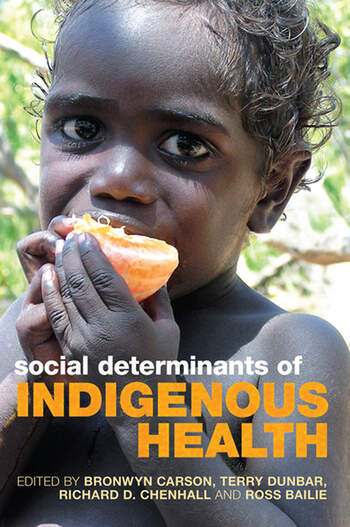
Social Determinants of Indigenous Health
2007
Author(s): Carson B, Dunbar T, Chenhall R D, Bailie R
The book offers a systematic overview of the relationship between the social and political environment and health.
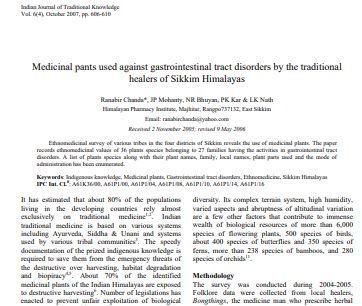
Medicinal Plants Used Against Gastrointestinal Tract Disorders by the Traditional Healers of Sikkim Himalayas
2007
Author(s): Chanda R, Mohanty JP , Bhuyan NR, Kar PK, Nath LK
Ethnomedicinal survey of various tribes in the four districts of Sikkim reveals the use of medicinal plants. The paper records ethnomedicinal values of 36 plants species belonging to 27 families having the activities in gastrointestinal tract disorders.

Indigenous Peoples in Latin America: Economic Opportunities and Social Networks
2007
Author(s): Patrinos H A, Skoufias E, Lunde T
Previous studies show that being indigenous is associated with being poor, and that over time that relation has stayed constant. Studies also show that indigenous peoples’ poverty has not diminished over time, including over the period of the world’s first indigenous peoples decade, 1994-2004 (Hall and Patrinos 2006). Furthermore, indigenous peoples suffer from many other disadvantages, and even when they are able to accumulate human capital this does not translate into significantly greater earnings or a closing of the poverty gap with the non indigenous population.

Edible Plants of Tropical Forests Among Tribal Communities of Madhya Pradesh
2007
Author(s): Pandey RK, Saini SK
In Madhya Pradesh, Baiga and Gond tribes are identified as the main collectors and users of forest resources among the forest dwellers. These non-wood forest products (NTFPs) have immense potential to meet the daily requirement of tribal communities and also a source of raw material supply to small pharmaceutical industries.

Edible Weeds of Tribals of Jharkhand, Orissa and West Bengal
2007
Author(s): Sinha R, Lakra V
The study identifies 43 species of weeds belonging to 36 genera and 26 families that are commonly consumed by the tribal population as per their availability.
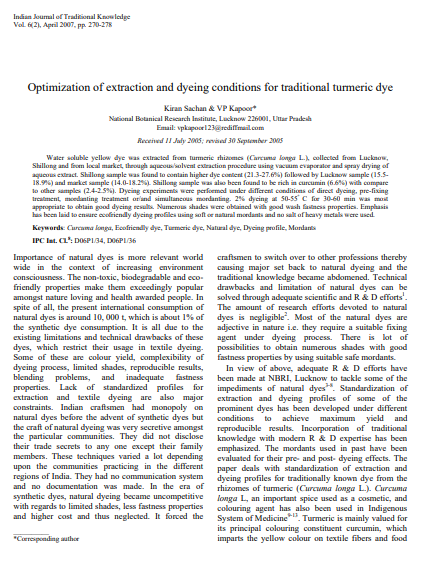
Optimization of Extraction and Dyeing Conditions for Traditional Turmeric Dye
2007
Author(s): Sachan K, Kapoor VP
This paper analyzed the dyeing condition of traditional turmeric dyes collected from Lucknow, Shillong and from local market, through aqueous/solvent extraction procedure using vacuum evaporator and spray drying of aqueous extract.