


Books

Knowledge and Systems Science Enabling Systemic Knowledge Synthesis
2016
Author(s): Nakamori Y
Integrating ideas from the fields of systems science and knowledge science, the book shows how to create and justify various pieces of knowledge systemically. Written by one of the foremost experts in this area, the book presents approaches for the systemic integration of knowledge, which can help solve complex problems today and in the future.

Indigenous Peoples, Customary Law and Human Rights: Why Living Law Matters
2016
Author(s): Tobin B
This book addresses the critical issues that are threatening the self-determination, land, resources, and cultural heritage of Indigenous peoples.

Handbook of Research on Theoretical Perspectives on Indigenous Knowledge Systems in Developing Countries
2016
Author(s): Ngulube P
The book presents interdisciplinary research on knowledge management, sharing, and transfer among indigenous communities. Providing a unique perspective on alternative knowledge systems.

The book is a synthesis of changes and innovations in methodologies in Indigenous Studies, focusing on sources over a broad chronological and geographical range. It offers insight into the methodological approaches contributors take to research, and how these methods have developed in recent years.
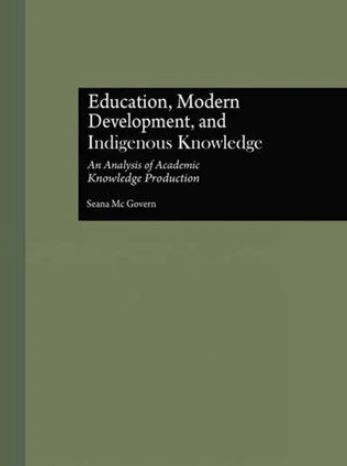
Education, Modern Development, and Indigenous Knowledge: An Analysis of Academic Knowledge Production
2016
Author(s): McGovern S
This book re-conceptualizes the field of international and comparative education by utilizing indigenous knowledge as a central component for altering the dominant, eurocentric social science research paradigm.

Nomadic and Indigenous Spaces: Productions and Cognitions
2016
Author(s): Miggelbrink J, Habeck J O, Mazzullo N, Koch P
This volume is devoted to aspects of space that have thus far been largely unexplored. How space is perceived and cognised has been discussed from different stances, but there are few analyses of nomadic approaches to spatiality

The book discusses numerous topics including various types of fermented foods, their origin, history and ethnicity, the role of fermented foods in health, and the microbiology and biochemistry of indigenous fermented foods. The composition and nutritive value of fermented foods are also addressed along with other aspects related to quality and safety, including the toxicity of indigenous fermented foods.

The study of indigenous religions has become an important academic field, particularly since the religious practices of indigenous peoples are being transformed by forces of globalization and transcontinental migration.

Indigenous Historical Knowledge: Kautilya and His Vocabulary (Volume II)
2016
Author(s): Gautam PK, Mishra S, Gupta A
This book is the second in a series of three volumes on “Kautilya and His Vocabulary” as a part of the “Indigenous Historical Knowledge” project undertaken by the Institute for Defence Studies and Analyses (IDSA), New Delhi. The edited volumes contain select papers presented in a series of workshops, national and international seminars organised by the Institute.

Indigenous Historical Knowledge, Volume I: Kautilya and His Vocabulary
2015
Author(s): Gautam PK, Mishra S, Gupta A
This book is the first in a series of three volumes on “Kautilya and His Vocabulary” as a part of the “Indigenous Historical Knowledge” project undertaken by the Institute for Defence Studies and Analyses (IDSA), New Delhi. The edited volumes contain select papers presented in a series of workshop, national and international seminars organised by the institute.