



Research Papers/Articles
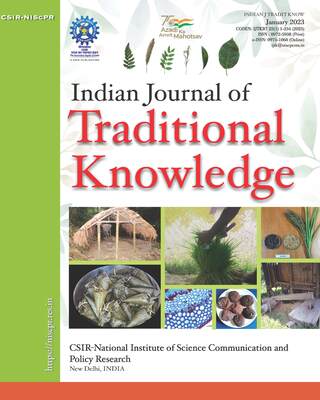
Traditional Meliponiculture by Naga tribes in Nagaland, India
2016
Author(s): Singh AK
In Nagaland, three species (Tetragonula irridipenis, Tetragonula laviceps and Lophotrigona canifrons) of stingless bees were observed; however, most of the beekeepers were rearing T. irridipenis. Stingless bees were found to prefer low light, high humidity, and stenothermal climatic conditions with diverse abundant flora. The traditional colony capture method of terrestrial and subterranean stingless bee was logical and practical and shows immense scope to introduce precise method with scientific interventions.

Diversity of Wild Edible Plants in Marat Longri Wildlife Sanctuary, Assam
2015
Author(s): Phangchopi U,Teron R,Tamuli AK
The present study revealed that 91 species of wild edible plants belonging to 79 genera and 45 families including 2 fern species are consumed by the inhabitants of Marat Longri Wildlife Sanctuary, Assam, India.

Indigenous Peoples in Domestic Work – Facing Multiple Discrimination and Disadvantage
2015
Author(s): Oelz M, Dhir RK
This study focuses on Indigenous women facing multiple forms of disadvantage and discrimination because of gender and identity, from both within and outside communities.
Analysis Of Impact Of Climate Change On Growth And Yield Of Yam And Cassava And Adaptation Strategies By Farmers In Southern Nigeria
2015
Author(s): Chukwuone N
This study determined the adaptation and coping strategies adopted by farmers under yam- and cassava based farming systems in Ebonyi and Enugu States in Nigeria’s derived savannah agro-ecological zone. The results of the study revealed that the main outcomes of climate change were flooding, decline in crop yields, food price increases, and food shortages/insecurity.

Perceived Effectiveness of Indigenous Traditional Fishing Methods Including Gears and Traps in Nagaon District of Assam
2015
Author(s): Saha B, Devi R, Kashyap D, Baruah DJ
Five practices were adopted by more than 50% of the farmers and except ITK-6 all these ITKs were perceived as highly effective, implying that many indigenous practices were both rational as well as effective.
Antioxidant Capacity and Polyphenolic Content of Seven Saudi Arabian Medicinal Herbs Traditionally Used in Saudi Arabia
2015
Author(s): Shahat AA, Ibrahim AY, Alsaid MS
In this study, alcoholic extract of seven plants from Tanhat protected area, Saudi Arabian, were studied for their antioxidant properties.
Phytochemical and Antimicrobial Activities of Himalayan Cordyceps sinensis (Berk.) Sacc.
2015
Author(s): Mehrotra MS, Kirar V, Vats P, Nandi SP, Negi PS ,Misra K
This study evaluated the phytochemical and antimicrobial activities and also quantified bioactive nucleoside using high performance thin layer chromatography (HPTLC) of five extracts of Indian Himalayan Cordyceps sinensis prepared with different solvents employing accelerated solvent extraction (ASE) technique.
Traditional Farming and Post Harvest Processing of Coconut by Nicobari Tribe
2015
Author(s): Velmurugan A, Swarnam TP, Sai TP , Roy SD
The present study encompasses a glimpse of a folk knowledge gleaned through survey on farming and post harvest processing of coconut a main source of livelihood activity of the tribals.
Network Ethnopharmacology Approaches for Formulation Discovery
2015
Author(s): Patwardhan B, Chandran U
This article briefly describes network pharmacology and demonstrates the Rasayana property of Triphalain the light of this emerging technique.

Survey of Wild Food Plants for Human Consumption in Elazığ (Turkey)
2015
Author(s): Polat R, Cakilcioglu U , Ulusan MD , Paksoy MY
This study aims to record accumulation of knowledge on plants which are used as food by local people of Elazığ that has a rich culture and a very natural environment.It is certained that wild plants being used for nutritional purposes by human beings are also used for medicinal purposes.