


Knowledge Hub

Indigenous women, daughters of Mother Earth
2020
Author(s): Food and Agriculture Organization of the United Nations (FAO)
This document presents some of the main challenges that indigenous women face and provide recommendations to eliminate the barriers that prevent indigenous women from achieving their full potential and their ability to contribute to the achievement of the 2030 Agenda for Sustainable Development.

Essential Rights for Community Forest Management
2020
Author(s): Friends of the Earth International
This paper outlines all the rights that peoples practicing CFM should enjoy. On the one hand, this is to ensure they can live in their territories, and be able to control their lives and preserve their cultures—which involve living in harmony with the ecosystems they inhabit. On the other hand, this would enable them to continue fulfilling the role of traditional caretakers and guardians of Nature, which ensures their ability to remain in their territories.

Measuring Regional Ethnolinguistic Diversity in Sub-Saharan Africa: Surveys versus GIS
2020
Author(s): Gershman B, Rivera D
This paper compares two approaches to measuring subnational ethnolinguistic diversity in Sub-Saharan Africa, one based on censuses and large-scale population surveys and the other relying on the use of geographic information systems (GIS).

The book provides a framework for how biodiversity can be detected and evaluated focusing particularly on plants using proximal and remotely sensed hyperspectral data and other tools such as LiDAR.

Training Manual on Forests and Trees for Food Security and Nutrition
2020
Author(s): Food and Agriculture Organization of The United Nations
The overall objective is to create awareness and enable increased investment in the forestry sector for food security and nutrition in Tanzania. This training manual is also meant to serve as a useful tool for sharing and exchanging knowledge and experiences across different regions (within the country) and beyond.

Patenting of Traditional Knowledge and its Benefit Sharing a Critical Review of Legal Frame Work in India
2020
Author(s): Pradnya P
The main focus of the study is the protection of the traditional knowledge which revolves around the indigenous people. In simple words no indigenous people, no traditional knowledge. The threat on traditional knowledge and its associated forms would increase, if exploitation on the indigenous people is not stopped, unfortunately it is the current scenario of the countries. The predicament is that the indigenous people have been ignored totally or with little provisions which are easily overlooked. Another predicament is that the traditional knowledge already lies in the public domain, is considered to be free and thus the multinationals takes advantage of it, and patent it.

A Film to Promote Sustainable Food System Practices
2020
Author(s): International Centre for Environmental Education and Community Development (ICENECDEV)
Promoting sustainable Food System in the Mount Cameroon Forest Region through Tradition/Indigenous Knowledge, Agroecology and Natural Farming Practices in providing healthy Food to Healthy People.
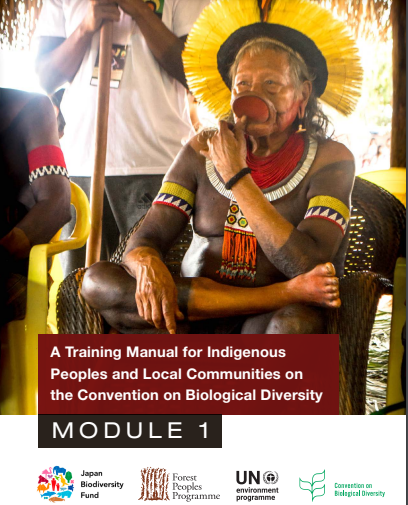
A Training Manual for Indigenous Peoples and Local Communities on the Convention on Biological Diversity - Module 1
2020
Author(s): The Secretariat of the Convention on Biological Diversity
Indigenous peoples and local communities (IPLCs) live in areas that overlap with zones high in biodiversity. These high biodiversity areas often are also rich in cultural diversity, as evidenced by the diversification of languages spoken in these areas. Considering this overlap, decisions concerning biodiversity may impact their lives. Strong knowledge about the international and national regulation and policy on biodiversity is important to enhance the full and effective participation of IPLCs in implementing the Convention on Biological Diversity (CBD) at all levels.

Indigenous Rights and Water Resource Management: Not Just Another Stakeholder
2020
Author(s): O'Bryan K
This book argues that a key means of ensuring appropriate participation in decision-making about water management is for such participation to be legislatively mandated. To this end, the book draws on case studies in Australia and New Zealand in order to elaborate the legislative tools necessary to ensure Indigenous participation, consultation and representation in the water management landscape.

Struggle for recognition of traditional seed in Brazil.
2020
Author(s): African Centre for Biodiversity (ACB)
Farmers’ seed, which is an intrinsic aspect of indigenous knowledge, constitutes the majority of seed used and exchanged. Crops produced from this seed contribute substantially to food and nutrition security for billions of people. However, these seeds receive scant recognition, and there is limited support for their reproduction, adaptation and use by farmers, for farmers.