


Knowledge Hub

Regional Consultation of Asia and the Pacific on the Implementation of Indigenous Peoples & Peasants’ Rights to Plant Genetic Resources for Food & Agriculture
2018
Author(s): International Planning Committee for Food Sovereignty
In this document, ‘farmers’ includes those who produce and/or use seeds in both industrial and cultural seed systems in line with Article 9 on Farmers’ Rights in the Seed Treaty. The custodians of cultural seed systems are referred to as ‘indigenous peoples and peasants’, and more broadly also include smallholders, artisanal fisherfolk, pastoralists, forest dwellers, women and all the communities that produce food in agroecological ways and contribute to maintaining biodiversity.

Mr Gregg Deal talks about the use of history as a tool while he navigates the restrictions thrusts upon his work as a contemporary artist while challenging those who hear his words to take responsibility for their knowledge, and create room for this nation’s First Peoples.

Spiritual and Cultural Value of Seed
2018
Author(s): African Centre for Biodiversity
This video, Spiritual and Cultural Value of Seed in South Africa, from a discussion group at the National Seed Dialogue and Celebration, hosted by the African Centre for Biodiversity at Constitution Hill in December 2017, explores some of these links in contemporary South Africa.

This episode of The Stream, featured conversation with Mr Jonathan Waterhouse, Indigenous Peoples Scholar, Portland State University, Mr Tero Mustonen, Researcher in Indigenous Knowledge and Climate Change and Ms Samantha Chisholm-Hatfield, Post-Doctoral Research Associate, Northwest Climate Science Adaptation Center.

Bridging Conservation Science and Traditional Knowledge of Wild Animals: The Need for Expert Guidance and Inclusion of Local Knowledge Holders
2018
Author(s): Ulicsni V, Babai D, Vadász C, Vadász-Besnyői V, Báldi A, Molnár Z
This study shows that accuracy of targeting the relevant species for knowledge co-production could be improved through specific understanding of the local culture,provided by experts who study traditional zoological knowledge and by local knowledge holders themselves.

The Regional Assessment Report on Biodiversity and Ecosystem Services for Europe and Central Asia
2018
Author(s): Rounsevell M, Fischer M, Torre-Marin Rando A, Mader A (Eds.)
This regional assessment provides invaluable information for policymakers in Europe and Central Asia to make informed decisions regarding the conservation and sustainable use of biodiversity.

Applying the TEEBAgriFood Evaluation Framework Overarching Implementation Guidance
2018
Publisher/Organisation: Global Alliance for the Future of Food
TEEBAgriFood Framework developed in 2018 has become a foundational reference for true cost accounting in food systems. A number of “proof of concept” applications have been completed, and a growing and diverse community including business leaders, policymakers, researchers, farmers, and civil society have been seeking to strengthen and mainstream the application of TEEBAgriFood.
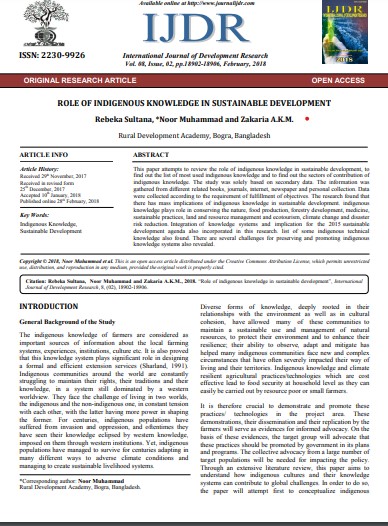
Role of Indigenous Knowledge In Sustainable Development
2018
Author(s): Sultana R, Muhammad N and A.K.M. Z.
This study attempts to review the role of indigenous knowledge in sustainable development, to find out the list of most used indigenous knowledge and to find out the sectors of contribution of indigenous knowledge.

Herbal Informatics Approach for the Selection of Natural Compounds Targeting Diabetes Mellitus
2018
Author(s): Tanwara A ,Zaidia AA, Bhardwaja M, Rathoreb A
In this study bio-prospection model were used where random search is included, followed by the index and rationale based selection of plant products targeting the diabetic factors.
TEEB for agriculture & food: scientific and economic foundations
2018
Author(s): The Economics of Ecosystems and Biodiversity (TEEB) Office, UN Environment
The TEEBAgriFood ‘Scientific and Economic Foundations’ report addresses the core theoretical issues and controversies underpinning the evaluation of the nexus between the agri-food sector, biodiversity and ecosystem services and externalities including human health impacts from agriculture on a global scale. It argues the need for a 'systems thinking' approach, draws out issues related to health, nutrition, equity and livelihoods, presents a Framework for evaluation and describes how it can be applied, and identifies theories and pathways for transformational change.