


Knowledge Hub
Cultural Significance and Diversities of Ethnic Foods of Northeast India
2007
Author(s): Singh A, Singh RK
The processing and preparation of ethnic foods not only demonstrate the creativity and treasure of food heritage of tribal women but also their incremental learning to sustain the life and ecosystem as a whole. Looking to the diversities in ethnic foods, an attempt has been made to explore the ethnic foods made of local soybean, bamboo shoot, tree bean, lai patta (leafy mustard) and rai (Brassica juncea (Linn.) Czern. & Coss.) from different selected tribes of Northeast India.
Natural Remedies for Heart Diseases
2006
Author(s): Lokhande PD, Jagdale SC, Chabukswar AR
In the paper, some of the plants and formulations, useful in the treatment of heart diseases have been summarized.
Traditional Medicine in the Treatment of Gastrointestinal Diseases in Upper Assam
2006
Author(s): Borah PK, Gogoi P , Phukan AC, Mahanta J
This paper presented an In-depth research on the use of medicinal plants to treat gastrointestinal diseases in Upper Assam. The findings show that 38 plant species from 36 genera and 29 families are used to treat a variety of gastrointestinal diseases.
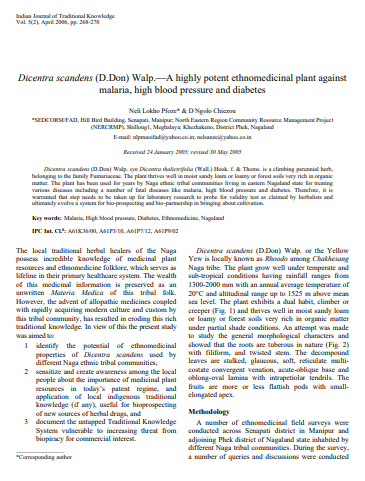
Dicentra Scandens (D.Don) Walp.⎯A Highly Potent Ethnomedicinal Plant Against Malaria, High Blood Pressure and Diabetes
2006
Author(s): Pfoze NL, Chiezou DN
This study demonstrates how the plant Dicentra scandens (D. Don) Walp. has been used traditionally to treat diabetes, high blood pressure, and malaria. A field surveys was conducted across Senapati district in Manipur and adjoining Phek district of Nagaland state inhabited by different Naga tribal communities.

Scheduled Tribes and Other Traditional Forest Dwellers (Recognition of Forest Rights) Act, 2006.
2006
Publisher/Organisation: Government of India
The Act encompasses Rights of Self-cultivation and Habitation which are usually regarded as Individual rights; and Community Rights as Grazing, Fishing and access to Water bodies in forests, Habitat Rights for PVTGs, Traditional Seasonal Resource access of Nomadic and Pastoral community, access to biodiversity, community right to intellectual property and traditional knowledge, recognition of traditional customary rights and right to protect, regenerate or conserve or manage any community forest resource for sustainable use.
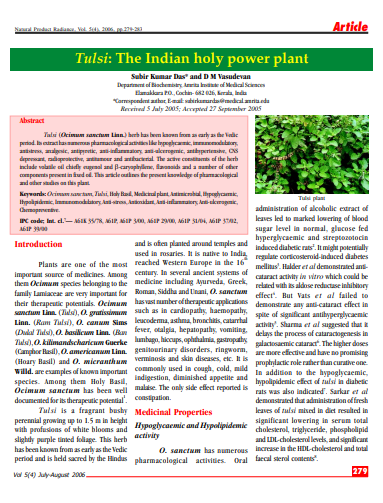
This article outlines the present knowledge of pharmacological and other studies on tulsi plant.
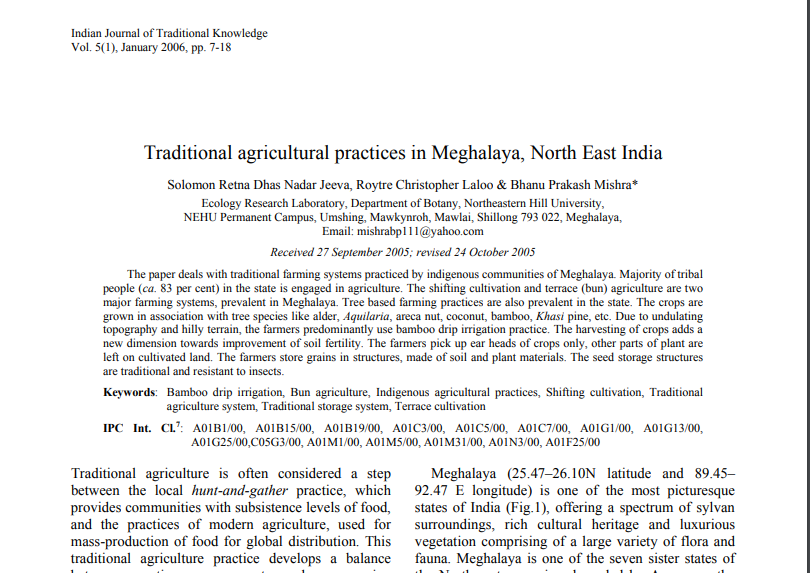
Traditional Agricultural Practices in Meghalaya, North East India
2006
Author(s): Jeeva SRDN, Laloo RC , Mishra BP
The paper deals with traditional farming systems practiced by indigenous communities of Meghalaya. Majority of tribal people (ca. 83 per cent) in the state is engaged in agriculture. The shifting cultivation and terrace (bun) agriculture are two major farming systems, prevalent in Meghalaya.

Ethnomedicinal Practices Among Khonds of Visakhapatnam District, Andhra Pradesh
2006
Author(s): Rao VLN , Busi BR , Rao B , Rao D
The paper provides information on 11 medicinal plants belonging to 10 families, used by Khonds for treatment of various ailments.

Indigenous Veterinary Practices of Darma Valley of Pithoragarh District, Uttaranchal
2006
Author(s): Tiwari L, Pande PC
The people residing in Darma valley known as Darmi or Darmi Bhotiyas have great wisdom of traditional knowledge about the animal husbandry and veterinary practices.They cure their animals with the help of surrounding natural resources such as plants, animals, minerals, etc.
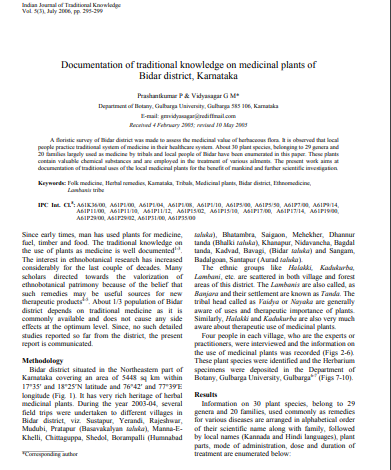
Documentation of Traditional Knowledge on Medicinal Plants of Bidar District, Karnataka
2006
Author(s): Prashantkumar P , Vidyasagar G M
The study aims at documentation of traditional uses of the local medicinal plants for the benefit of mankind and further scientific investigation.