


Training Materials
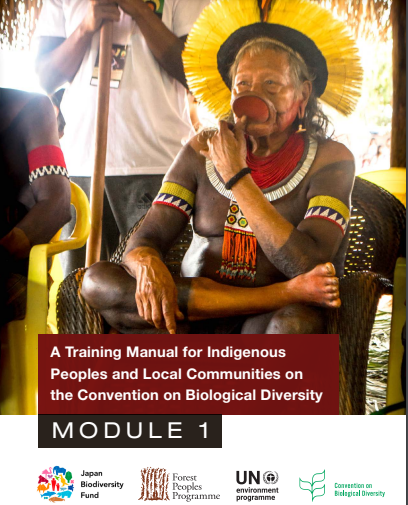
A Training Manual for Indigenous Peoples and Local Communities on the Convention on Biological Diversity - Module 1
2020
Author(s): The Secretariat of the Convention on Biological Diversity
Indigenous peoples and local communities (IPLCs) live in areas that overlap with zones high in biodiversity. These high biodiversity areas often are also rich in cultural diversity, as evidenced by the diversification of languages spoken in these areas. Considering this overlap, decisions concerning biodiversity may impact their lives. Strong knowledge about the international and national regulation and policy on biodiversity is important to enhance the full and effective participation of IPLCs in implementing the Convention on Biological Diversity (CBD) at all levels.

Training Manual on Forests and Trees for Food Security and Nutrition
2020
Author(s): Food and Agriculture Organization of The United Nations
The overall objective is to create awareness and enable increased investment in the forestry sector for food security and nutrition in Tanzania. This training manual is also meant to serve as a useful tool for sharing and exchanging knowledge and experiences across different regions (within the country) and beyond.
Gender in Adaptation Planning for the Agriculture Sectors
2019
Author(s): Nelson S , Hill C
The emphasis is on adaptation in agriculture, however the materials can be applied to planning for climate change adaptation in other sectors. In addition to this Guide for Trainers, there are companion PowerPoint templates that workshop organizers can tailor to their specific context.
WIPO Good Practice Toolkit for CMOs (The Toolkit)
2018
Author(s): World Intellectual Property Organization
Collective Management Organizations (CMOs) typically exist in a situation where it would be impossible or impractical for owners of copyright and related rights to manage their rights directly, and where it is to their advantage that the licensing of the rights that they own or represent be aggregated with a CMO.

Six (6) Guidelines for Projects Involving Traditional Indigeneous Knowledge
2018
Author(s): Indigenous Corporate Training
In 2018 the federal government proposed a replacement for the Environmental Assessment Act, that, if assented to should increase the incorporation of TK in the environmental assessment process. The proposed Impact Assessment Act, will “show how a proposed project could affect the environment, health, society, and the economy, as well how the development would impact Indigenous people over the long term.”

Linking People for Quality Products: Sustainable Interprofessional Bodies for Geographical Indications
2017
Author(s): Damary P , Bernardoni P , Couillerot C , Perret A
The content and theory pages of this training manual set out the basic concepts, while the exercise sheets provide for participative activities. The trainer notes, together with the introduction, guide trainers in the preparation of tailored training in relation to the five steps of the virtuous circle.

Addressing Agriculture, Forestry and Fisheries in National Adaptation Plans – Supplementary Guidelines
2017
Author(s): Karttunen K,Wolf J , Garcia C , Meybeck A
The Guidelines aim to support developing countries in: i) reducing vulnerability of the agriculture sectors to the impacts of climate change by building adaptive capacities and resilience; ii) addressing agriculture in the formulation and implementation of NAPs; and iii) enhancing the integration of adaptation in agricultural development policies, programmes and plans.

Water and Sanitation Services: Achieving Sustainable Outcomes with Indigenous Peoples in Latin America and the Caribbean
2016
Author(s): World Bank Group
The Toolkit summarizes the findings of interviews, consultations, and field visits carried out by a multi-sector, multi-national World Bank Team in 37 Indigenous communities17 located in urban, peri-urban and rural areas in seven LAC countries (Panama, Nicaragua, Paraguay, Argentina, Peru, Colombia and Bolivia) where the World Bank of other development actors had implemented WSS projects with Indigenous peoples.

Free Prior and Informed Consent - An Indigenous Peoples’ Right and a Good Practice for Local Communities: Manual for Project Practitioners
2016
Author(s): Food and Agriculture Organization
This manual deeply rooted in a human rights based approach, is designed to assist development organizations to respect the right to FPIC when developing and implementing projects affecting Indigenous Peoples. The manual contains a six-step procedure to facilitate the FPIC process while showing its benefits, as well as providing the regulatory framework to be used when mainstreaming Indigenous Peoples’ rights within organizations’ policies and standards.

Training tools for Curriculum Development: Reaching Out to All Learners: A Resource Pack for Supporting Inclusive Education
2016
Author(s): UNESCO International Bureau of Education
This guide provides a framework that is intended to stimulate discussion of these issues among policy- makers within a country. It presumes that the aim of inclusive education is to eliminate social exclusion that is a consequence of attitudes and responses to diversity in race, social class, ethnicity, religion, gender and ability